
May 2025
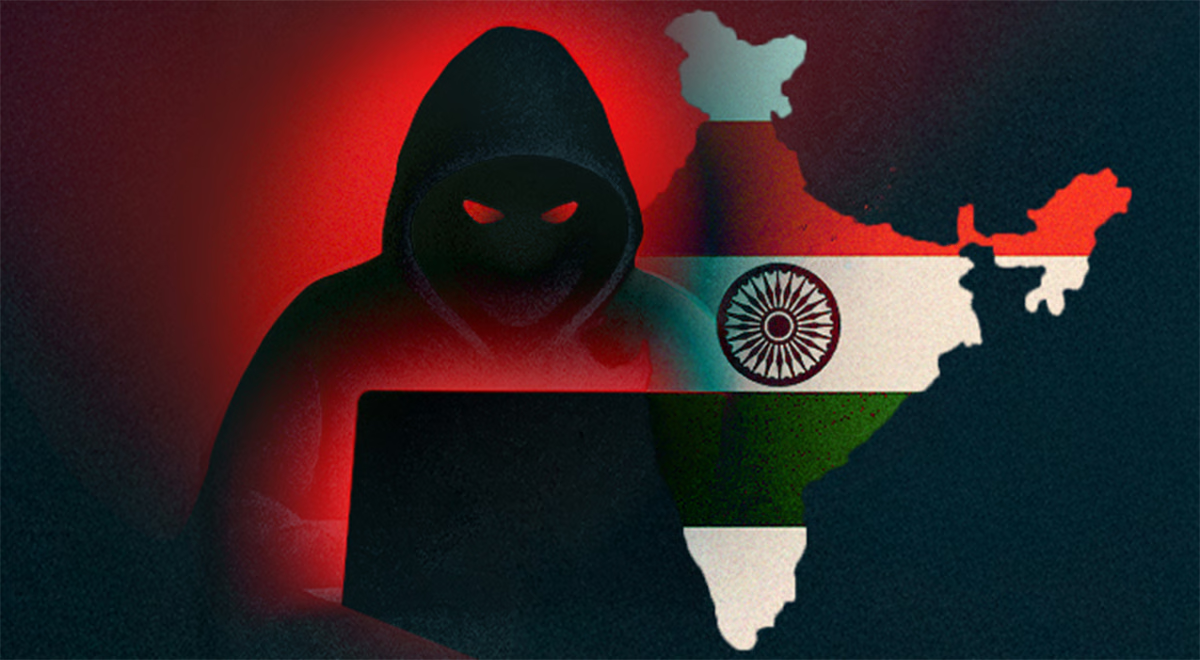
The South Asian subcontinent has, in the last decade, entered a phase in which the security architecture is changing faster than the institutions can follow. Between India and Pakistan, a new axis of conflict develops. There are no open fronts. There is a silent escalation. It is a space in which “the encryption of power” becomes the key instrument, and cyber-rivalry shifts into the domain in which algorithms are being used as an extended hand of politics.
After the abolition of the autonomy of Jammu and Kashmir in 2019, both countries went into the mode of conducting more intense digital operations. Attacks became more frequent, more compressed, and precisely directed. Until 2025, the conflict stabilized into the model of “algorithm politics”, where state and non-state structures are increasingly melting together. The cyber-space serves as a channel for the signalization of power, pressure, and covert operations. The militarization of the region is only adding another layer to this digital dynamics.
Early attacks from the 2010s were primitive. Defaces, propaganda slogans, and short demonstration of force. After 2020, the arsenal changed. The strike points become energy systems, telecommunication networks, financial clusters, and transport infrastructure. The attacks are no longer seen as sporadic incidents, but as a part of a strategy. This is the new architecture of pressure, projected to penetrate the digital sovereignty of the enemy.
The Indian Cyber Defense Agency is increasingly identifying operations linked with actors under the control of Islamabad. On the other hand, the Pakistani centers are accusing New Delhi of systemic digital monitoring and destabilization, often via civilian tech companies that allegedly serve as covers for military programs. The accusations spin in a loop that resembles an infinite algorithm: each side creates its own narrative, locked in its own encryption of power.
The biggest risks in the last few years are linked to the attacks on energy and telecommunication infrastructure. The northern part of India and key hubs in Pakistan are under constant testing. These incidents often follow spikes in tensions along the demarcation line in Kashmir. The physical and digital forces are operating increasingly synchronized. As two parallel networks that occasionally intertwine and create a possibility of a short fuse.
The hybrid character of the conflict is additionally strengthened by semi-official hacking groups. The Indian Cyber Force hacking group functions as an extension of state structures, but without any formal obligation of responsibility. It is a mechanism that enables the conduct of highly intense operations with minimal diplomatic spending. The model is simple: maintain offensive capacity, avoid political risk.
Disinformation campaigns have become a mandatory module of this system. During the Ladakh crisis in 2024, we witnessed a growth of 40% of fake accounts linked with political actors. Both sides use digital platforms to form narratives and strengthen national impulses. The information is being treated as a resource whose value is growing faster than any traditional form of power.
The cyber space is functioning as a laboratory of hybrid warfare. Infrastructure is the battlefield. Data are ammo. The governments are using the argument of “cyber threats” to push laws on monitoring and strengthened control over networks. Digital sovereignty is becoming a concept that is being interpreted widely and applied selectively. In practice, this means more state meddling and less space for civic freedoms.
Even though this conflict is primarily bilateral, its geopolitical footprint is quite wider. South Asia is a zone in which the interests of the US, China, and Russia intertwine. The Chinese support to Pakistan through CPEC also includes clearly profiled cyber components. India, on the other hand, is deepening its partnership with the US and Australia through the Indo-Pacific Cyber Resilience Partnership. Global powers are using this local conflict as a testing space for their own technological strategies.
International organizations are attempting to establish norms of behavior in the cyber domain, but without real success. Neither New Delhi nor Islamabad intends to reduce its offensive capacities. To the contrary, they perceive them as the key elements of national security. This creates a matrix in which each attack can be wrongly understood, and each mistake upon attribution can cause a chain reaction.
In May 2025, the conflict seems stable, but stability can deceive. It is a digital balance of fear. The border holds only because neither side wishes to test the consequences of complete cessation. The integration of digital and military instruments increases the ability of an incident that escapes control. Especially in an environment where there is no trust in the common protocol.
The subcontinent is entering an era in which nuclear deterrence is not enough anymore. Cyber deterrence thus becomes the new pillar of stability. The lines being drawn nowadays do not pass through the mountain valleys of Kashmir, but through servers, networks, and algorithms that shape the digital landscapes of both countries. It is a new field, in which the conflict is defined, covered, and sometimes – unintentionally – escalates.
Author: Aleksandar Stanković