
Publications
Violeta Rašković Talović – Medallions of Russia, 2018, Center for Strategic Prognosis
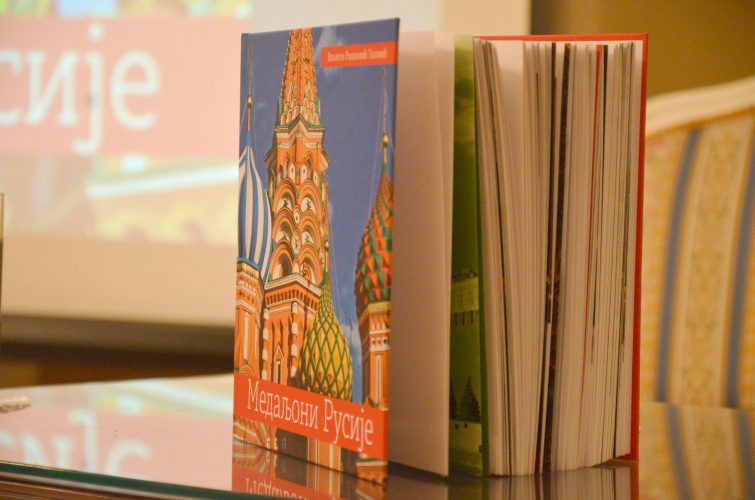
The book Medallions of Russia, authored by Professor Dr Violeta Rašković Talović, is an exceptional combination of a travelogue, a cultural-historical essay, and a photographic monograph, designed as a multi-layered testimony of the Russian spirit, art, and tradition.
On almost four hundred pages (more precisely, 395), the author guides the reader through Russia in a series of “medallions” – individual fragments that together form a complete picture of a country whose history, spirituality, and artistic expression are inextricably linked.
Through carefully selected topics, Dr Rašković Talović sheds light on the key points of the Russian cultural and spiritual vertical. The book includes meetings with the great names of Russian literature – Pushkin, Gogol, Lermontov, Tolstoy, Dostoyevsky, and Yesenin – but also conversations with contemporary Russian artists, scientists, and cultural workers. On her intellectual journey, the author does not approach Russia solely as an object of research but as a space of spiritual exploration, seeking to understand the inner meaning of Russian civilization and its enduring connections with Serbian cultural identity.
Medallions of Russia, published in 2018 as part of the publishing activity of the Center for Strategic Prognosis, are supplemented with rich visual representations: each unit is completed with authentic photographs, which contribute to the atmosphere of the voyage and allow the reader to experience Russia not only through words, but also through images. The book is conceived as a kind of bridge between research and art – as a combination of documentary and lyrical, intellectual and emotional, rational and spiritual.
At the basis of this work lies the author’s deep understanding of the Russian “world” as a complex cultural and spiritual phenomenon. Her “medallions” are not only descriptions of places and people, but reflections on historical experiences, aesthetic values, and spiritual aspirations of a nation whose influences inspired and shaped many areas of civilization, including the Serbian one.
As a book that documents, reflects, and experiences at the same time, Medallions of Russia transcends genre boundaries – it is both a travelogue and an essay, a study and a confession. That is why it represents valuable reading for cultural researchers, art historians, literary theorists, but also for a wider audience, who want to understand the complexity of the Russian tradition and its deep connection with the Serbian cultural space.
Medallions of Russia is, ultimately, a testimony of the search for meaning through the meeting of cultures – a book that, like its titles, gathers precious fragments of a people and turns them into a spiritual whole, intended for the reader ready to travel with thoughts,
memories, and feelings.
Dragan Stanar i Miša Stojadinović (ed.) – Geopolitical and Security Challenges in Southeastern Europe, 2019, Center for Strategic Prognosis
Gathering twenty-one prominent experts in the field of geopolitics and security studies, the Center for Strategic Prognosis published in 2019 a collection of the most significant political analyses that deal with these issues in the form of the monograph Geopolitical and Security Challenges in Southeastern Europe.

The monograph, which was originally published in English under the title Geopolitical and Security Challenges in Southeastern Europe, is a collection of works by domestic and foreign authors dealing with key geopolitical, security, and strategic processes in Southeastern Europe. The editors of the publication, Dragan Stanar and Miša Stojadinović, gathered a team of experts in the fields of international relations, security, geopolitics, and political science, with the aim of providing a comprehensive view of the challenges and opportunities that shape this dynamic region.
The publication analyzes the position of Southeast Europe at the crossroads of the interests of the great powers, with special reference to the influence of the European Union, NATO, the Russian Federation, Turkey, and China. The authors point to the complex processes of transformation of political systems, economic and energy dependence, migration, and new forms of security threats, including hybrid and information wars, energy policy, regional cooperation, and relations within the transatlantic space.
The special value of the monograph lies in its interdisciplinary approach: the texts combine theoretical insights, current case studies, and strategic analyses. In this sense, the book is a valuable resource, both for scientists and researchers, as well as for decision-makers, students of international relations, analysts, and the general professional public interested in security trends in the region.
Thanks to the contribution of numerous authors from Serbia, North Macedonia, Montenegro, Bosnia and Herzegovina, Bulgaria, and other countries, the monograph offers a regional perspective that connects local challenges with global trends. At the same time, it affirms the idea that Southeast Europe is no longer just a periphery, but an area of key importance for understanding contemporary European and world geopolitics.