
December 2025
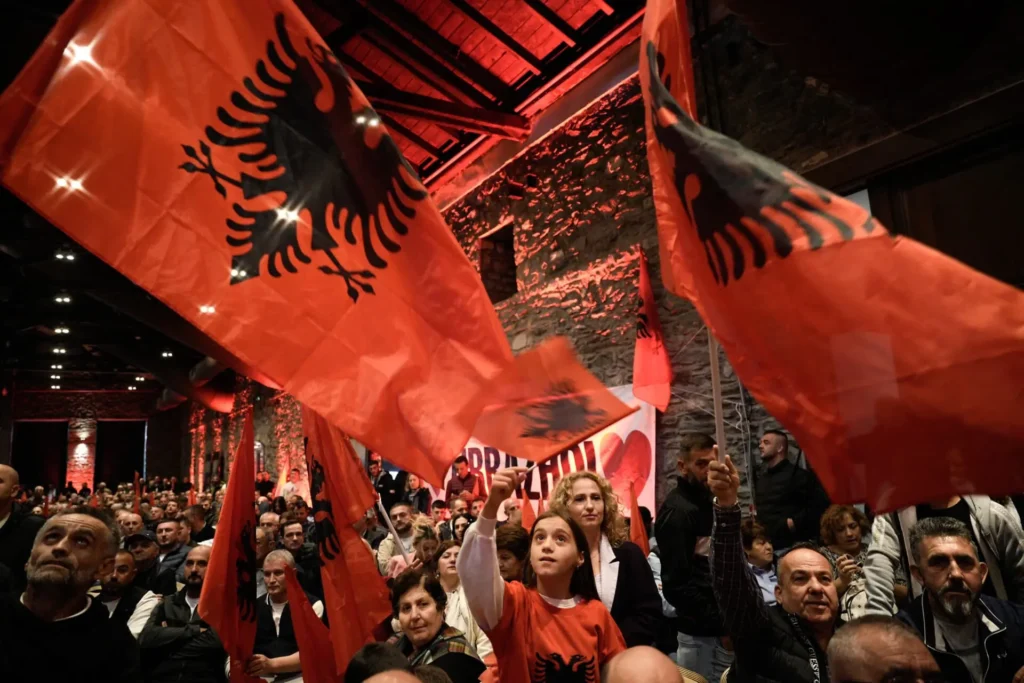
Since the beginning of 2024, Albania has been in a state of enhanced political tension, clearly manifested through waves of protests in Tirana and other cities. The first big protests erupted on February 20, 2024, after the allegations against Edi Rama for corruption and statements of political instrumentalization of the judiciary, when the protesters clashed with the police in front of government institutions. A new wave followed on October 7, 2024, when the opposition protested because of the incarceration of a parliament member and the demands for the formation of a technical transitional government before the 2025 elections, with violent incidents and attacks against the headquarters of the ruling Socialist Party. The protests then continued in the form of roadblocks throughout the country, while at the end of 2025, population gatherings emerged with demands for the deposition of the Prime Minister. As we see, the protests are still not ending, which tus serves us as a sort of an invitation to examine them analytically, since it is evident that the current crisis is not linked to a single event, but represents a continuing process. This opens up a series of questions about the stability of the political system and the capacity of the institutions to absorb the political conflict.
Namely, the protests in Albania represent a permanent symptom of a deeper political crisis, and not an isolated episode of political dissatisfaction. They point to the existence of a structural disorder of the system that has, for a while, been showing the signs of chronic instability. As in medicine, where an illness cannot be explained solely through external manifestations, these protests as well cannot be understood without a wider analysis of the institutional framework. Therefore, it is important to examine the cause of the crisis, its intensity, and potential outcomes.
The political system of Albania has for years been functioning under a constant pressure of a conflict between the government and the opposition, whereas the institutional mechanisms are increasingly ogten losing their intermediary role. Instead of a dialogue, confrontation dominates, and instead of compromise, a political blockade. In other words, the system is not reacting adaptively to political stress, but it is additionally deepening it, thus questioning the ability of the institutions to ensure elementary political stability.
The formal causes of protests are most often linked to allegations of corruption, disputes regarding electoral results, or the decisions of the executive power, but these causes do not represent the essence of the problem. Analytically examined, they look like triggers, while the cause can be found deeper, in the political DNA of the system that favors polarization and personalization of power. In other words, the system is acting predictably, but without the ability to reform from within. This opens up a series of questions about its long-term sustainability.
The opposition uses the protests as a central political instrument in an attempt to delegitimize the government and put pressure outside institutional channels. The government, on the other hand, perceives the protests, above all, through the prism of security and legal order, insisting on control and order. Between these two positions, there is not much space for mediation. In other words, the political scene functions per the logic of a conflict without a way out. In such an environment, social immunity weakens. Citizens face constant crises, which, in time, produce political fatigue and reduce capacity for long-term mobilization. Protests become frequent, but they lose their transformative potential, while the distrust in the institutions stops being an exception and becomes a rule. The society adapts to crises, but does not overcome them. This opens up a series of questions about the future of political participation.
At the same time, the virus of instability, acting gradually and systemically, is spreading. It first weakens the institutional cohesion, then the legitimacy of electoral processes, and finally affects the economic and foreign policy priorities of a country. In other words, the political crisis grows into a general state of the system, shedding light on the issue of the limit of endurance of the Albanian state.
The role of international actors additionally complicates this clinical image. The European Union insists on reforms and institutional consolidation, but acts carefully and often indecisively. The United States is sending political signals, but deflects from direct participation. In other words, the external pressure exists, but does not have a unique therapeutic strategy. This is opening up a series of questions about the real range of international mediation.
If we apply the medical analogy, it is clear that the therapy reduced to the mediation of symptoms cannot lead to a permanent cure. Albania is facing exactly this type of an approach, where some segments of the system are reformed, while the political DNA remains unchanged. The crisis is kept under control, but is not solved.
The media, in this context, have a significant role because they often act as amplifiers of political conflict, and rarely as a collective factor. Their reporting rarely contributes to polarization and political mobilization but rather to rational analysis. Informing the popular masses turns into an extension of political fight, where the professional standards are being diminished, and the responsibility of a journalist towards the public space is devalued.
Looking from an analytical perspective, the protests in Albania do not point to political vitality, but to an institutional dysfunction. In more stable systems, protests complement the institutions, while in the Albanian case, they often replace them. In other words, the street is becoming a part of a regular political mechanism. This opens up a series of questions about the border between legitimate pressure and a more long-term erosion of the system.
In conclusion, the political crisis in Albania is exhibiting a clear tendency of self-reproduction through protests, conflicts, and permanent mistrust. Without strengthening the social immunity, and without an essential change in the political DNA, this cycle will continue, because stability cannot be reached without deep procedures on the system itself.
Author: Miloš Grozdanović