
December 2025
The Western Balkans is again entering a period of deep political instability, but unlike earlier decades, the present chaos does not look like temporary turbulence but like a permanent condition. The region functions without a clear strategic direction, without consensus about a future geopolitical anchor, and without the capacity to generate from inside sustainable political and institutional changes. Instead of reforms and vision, crises dominate, which are maintained, frozen, or instrumentalized – depending on who, when, and why it is convenient. The Balkans has stopped being a space where conflicts are resolved; it has become a space where conflicts are carefully “managed,” sometimes even produced, to maintain balances that suit domestic elites and external actors.
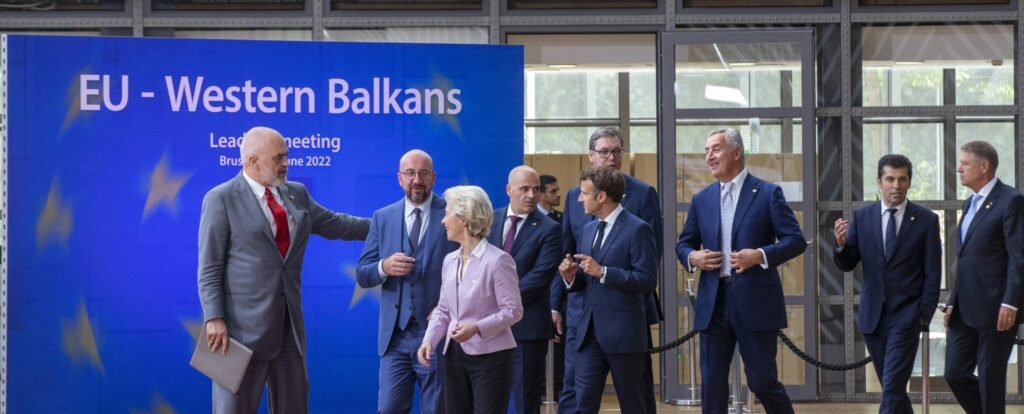
The European Union remains a nominal strategic goal of the states of the region, but the credibility of Brussels has seriously eroded. The promise of enlargement has turned into a technical process without political will, which regional leaders recognize very well and use. In such an environment, European integrations are no longer a tool for democratization, but an instrument for internal legitimization: authorities refer to the “European path” while at the same time undermining independent institutions, suppressing media freedoms, and using EU rhetoric as cover for centralization of power. Brussels responds with ritual statements about “progress and challenges,” but does not take essential steps. The result is a vacuum in which the EU has formal authority, but loses real influence.
The United States occasionally enters regional processes, mostly when it wants to prevent escalation – the question of “Kosovo”, Bosnia and Herzegovina, and the relation of Serbia toward sanctions on Russia. However, American diplomacy today does not have that stable strategy it had at the beginning of the 2000s. Washington acts reactively, through ad hoc missions that solve urgent problems, but do not offer a long-term architecture of political order. At the same time, American expectations toward local leaders are often based on personal connections and perception of reliability, which creates additional asymmetries and opens space for manipulation. Leaders in the region have learned how to balance between the demands of Washington and Brussels, promising one thing, doing another, and at the same time maintaining stability only to the extent that it serves their survival in power.
In contrast, Russia and Turkey use strategies based on symbolic capital: history, religion, identity narratives, and political rhetoric of independence from the West. Moscow, despite limited resources and international isolation, maintains political influence through diplomatic rhetoric, energy ties, and support to actors who position themselves as a counterweight to the West. Turkey, on the other hand, uses a combination of economic expansion, investments, and cultural presence to strengthen its soft power. These powers do not offer the region stability, nor a clear political vision, but they offer an alternative – or at least an illusion of alternative – which is enough to disturb the monopoly of the EU and the US over the regional agenda.
Political crises within the states themselves further complicate the picture. Bosnia and Herzegovina is trapped in institutional architecture designed for peace, not for development; “Kosovo” and Serbia conduct parallel narratives about normalization, where each negotiates only for domestic audience; Montenegro hesitates between redefinition of identity and attempt of institutional resetting; North Macedonia after the Prespa Agreement remains without visible progress, which strengthens the feeling of political frustration; Albania balances between strong centralization of power and attempt to position itself as regional stabilizer. The whole region functions as a set of mutually connected tensions, where internal crises spill over into bilateral disputes, and bilateral disputes into regional processes.
In parallel with internal dynamics, diplomatic games from outside additionally contribute to the absence of a compass. The EU and the US want stable Balkans, but often have different priorities and tactical approaches. Russia and Turkey do not want destabilization to the point of conflict, but they have an interest in preventing Western consolidation of the region. China observes the Balkans as a logistical and investment point within the broader framework of the Belt and Road Initiative, but without the ambition to resolve political problems. This geopolitical multilayeredness creates a paradox: the Balkans has never been exposed to a greater number of international actors, and never had less strategic clarity.
At the same time, societies of the region remain trapped between unrealistic expectations and deep disappointment. Ordinary citizens believe less and less in political institutions, but at the same time depend on them more and more – on social benefits, party employment, and state infrastructure that is unevenly distributed according to political loyalty. Migration of youth further weakens the social potential for change, because those who could be carriers of reforms often leave, while those who remain lose confidence that changes can be implemented from inside. Such a condition enables political elites to rule over a region that is exhausted, depoliticized, and fragmented.
Cumulatively, the Balkans without compass is a region that functions in permanent transition without a goal. Integrations are promises without outcome, reforms are processes without result, and conflicts are a constant companion of political reality. International actors maintain the illusion of progress, while local elites maintain the illusion of stability – and both know that these illusions are thin, but at the same time useful. What is missing is not only strategic direction, but consensus about what kind of Balkans it actually wants to be: region integrated into European political architecture, zone of autonomous development, or geopolitical buffer between great powers. Until that answer is found, the Balkans will remain a space of diplomatic games, frozen calculations, and fragile balances – a region that does not sink, but also does not advance; a region that survives, but without a compass that would lead it forward.
Autor: Krasimir Tanchev