
December 2025
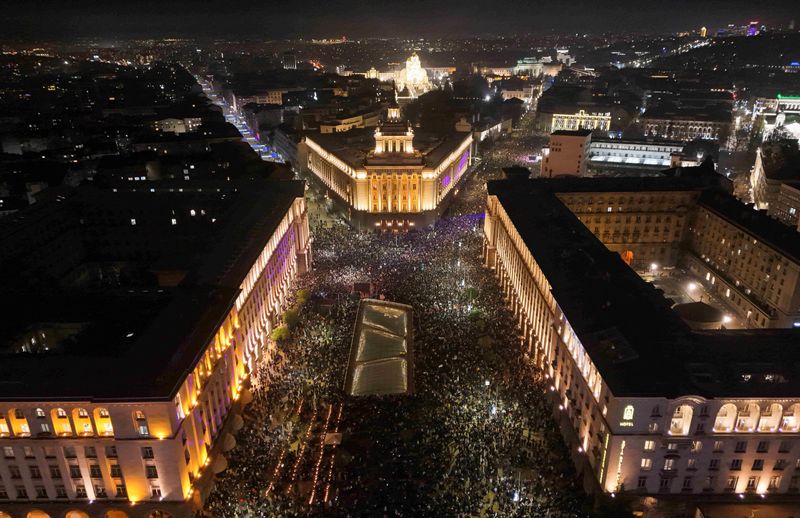
The Government in Bulgaria resigned on December 11, 2025, just before the scheduled vote of no confidence in te Parliament, after many weeks of mass protests that gathered in Sofia and other bigger cities dozens of thousands of citizens dissatisfied with the deeply rooted corruption, economic pressures, and the way the executive government attempted to pass the budget solutions for 2026, which made the political crisis more visible even outside the narrow party circle. Regarding this, the resignation of the Government did not occur as a sudden crash, but as a logical ending to a process in which the political legitimacy was spent faster than the institutional capacities, while the street became the key corrective of the government.
Bulgarian politics has been operating for years in a pattern that combines frequent elections, fragile coalitions, and constant tension between formal institutions and society, whereby the crisis is not perceived as an exception, but as a normal state of the system. The analytical depth of the crisis is reflected in the fact that the protests do not only articulate resistance to one government, but to the entire way of governance in which the anti-corruption discourse is used selectively, and reforms remain partial and tactical. In this regard, political actors consciously maintain a state of controlled chaos because such a framework allows them to survive without real responsibility.
The wave of protests from December 2025 clearly showed that the social energy in Bulgaria is no longer exclusively linked to parties, but to a broader sense of institutional injustice, which the government did not succeed in channeling through dialogue or credible political offers. The Government acted defensively, focusing on the procedural issues and technical arguments, while the protesters insisted on political responsibility and systemic changes. Regarding this, the cleavage between the Government and the citizens additionally widened, because both sides spoke different political languages.
The security dimension of this crisis remained formally stable, but fundamentally shaped the behavior of the institutions, as the authorities tried to keep the protests under control without open repression, aware of the international context and obligations that Bulgaria has as a member of the European Union and NATO. In this regard, the security architecture of the state continued to function, but the political content of that stability remained thin, because stability was maintained by procedure, not by trust.
At the same time, the public discourse increasingly slid towards the securitization of everyday life, in which economic problems, corruption, and protests were interpreted as risks to the state order, rather than as legitimate political demands. Political actors consciously used such a framework in order to relativize the protesters’ demands and divert attention from their own responsibility. In this regard, politics again distanced itself from society, while the administration assumed the role of the main manager of the crisis.
The fall of the Government in December 2025 opened up the issue of further steps, but did not bring along any clear responses, because Bulgaria is entering into another cycle of technical solutions, transitional arrangements, and political negotiations that rarely produce strategic breakthroughs. The political elites are already preparing new election narratives, while the essential issues of judicial reform, the fight against corruption, and the redefinition of the relationship between the authorities and citizens are once again pushed into the background. In this regard, the crisis is not solved, but its intensity is managed.
The Bulgarian case, therefore, goes beyond the national framework and offers a broader insight into the limitations of post-transitional democracy in Europe, where formal institutional standards are maintained, but the political substance remains fragile. The analytical depth of the crisis lies precisely in the ability of the system to survive without real stability, relying on controlled chaos as the basic functioning mechanism. In this regard, the fall of the Government does not represent the end of a political chapter, but the continuation of the process in which Bulgaria remains trapped between the demands of society and the adaptive inertia of the political elite.
Author: Miljan Petrović