June 2025
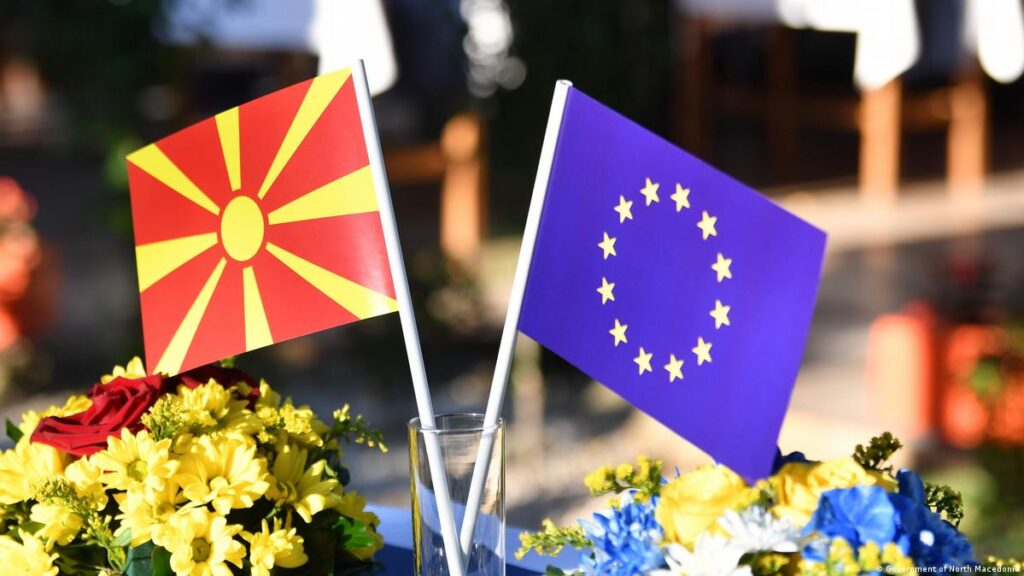
Five years after the EU opened up negotiations with North Macedonia, I notice that the country is once again at the crossroads, wandering between a historical chance and a serious fatigue with reforms, and all this in a moment when the government is still pushing for the European course, even declaratively. They are maintaining the image of decisiveness, even though their dispute with Bulgaria is drawing them back and is raising temperatures in the domestic public. And then, while the Union is fighting the consequences of the war in Ukraine, attempting to shape its security architecture and position the expansion towards the East into a new analytical depth of a crisis, the Western Balkans suddenly gained a new geopolitical value, but not enough for Skopje itself to enter the fast track of European integrations.
Regarding this, the dispute with Bulgaria does not seem like a simple dispute about history books, but as a broader challenge: how can the EU even absorb national narratives that are conflicting with its common values and institutional reflexes? And while we are all recalling that North Macedonia signed the Prespa Agreement in 2018 and thus opened up its doors to NATO, Bulgaria set new conditions in the period from 2020 to 2022 and made a deep polarization within the society. People are increasingly often perceiving EU integrations as something humiliating, and not as a chance, and in this controlled chaos, the trust in the EU declines, being at around 48% in 2025, while Skopje is more and more glancing towards Ankara and Beijing as its partners in reserve.
In the meantime, the government is continuously implementing reforms in the fields of rule of law and the fight against corruption, and it is cooperating with the European Commission and SIGMA, but regarding this, it is becoming increasingly clear that the technical preparedness is no longer a problem, but the symbolic capital of the process is. If the EU does not show that it treats North Macedonia as a serious candidate, but only as an instrument of regional stability, then the entire process becomes bitter. Bulgaria is using the rule of the unified vote within the EU Council and is keeping its finger on the brakes in the negotiations, and thus, even though there have been negotiations during the last few years, commissions are formed, cultural cooperation is promoted, and the dispute remains clearly political. And the EU, busy with its own dilemmas, is still not finding the mediation model to pull the region out of this securitization of everyday life and enable the institutional mechanism against bilateral blockages.
Regarding this, I wish to note that the EU has zealously widened its agenda since 2022 to Ukraine, Moldavia, and Georgia, thus casting a shadow on the Western Balkans. North Macedonia enters the grey zone: it is mature enough to wish not to be a mere observer, but not enough of a priority to enter the first round of expansion. The New Growth Plan for the Western Balkans from 2024 looks good on paper, but in practice, it more resembles a technocratic tool than a political strategy, especially given the fact that France and the Netherlands are deciding about the expansion dynamics without any hurry.
Moreover, the new generation of European leaders is increasingly loudly claiming that there will be no expansion without an internal reform of the EU, and thus, this practically means that the candidate states should conduct deeper reforms without a clear date for their membership, which is producing frustration, risk from radicalization, and big political oscillations. In Bulgaria, where coalitions barely last, and the public scene is sliding from one polemic into another, the dispute with Skopje is still conditioning the process with historical interpretations, which can undermine the credibility of the EU and push Bulgaria into the position of a loud minority actor that acts as an anomaly of the European foreign policy.
If the region wishes to get out of this pause, I predict several key moves. The EU must institutionalize the mechanism of bilateral mediation that prevents disputes from becoming hostages of political blackmail; North Macedonia must shift focus from symbolic to economic convergence, digital transformation, and strengthening of institutions; the region must renew the network of cooperation through the Common Regional Market and Open Balkan, thus creating the space of economic cohesion that accelerates political processes. And of course, European institutions must understand that fatigue from expansion is changing the geopolitical map – each pause leaves space for other actors.
In the end, North Macedonia is becoming a test of the credibility of European expansion. If the EU allows for bilateral disputes to become permanent mechanisms of blockage, it will lose both the region and one of its strongest instruments of stability. But if Skopje survives the pressure, continues its reforms, and maintains its course, then it is creating a model of a “small country of big resistance”, which, regarding this, becomes an interesting paradigm for a new Europe that no longer inherits stability – but builds it once again.
Author: Miljan Petrović