September 2025
At the beginning of 2025, the international system witnessed the strengthening of political and strategic cooperation between Russia and North Korea – two actors that, despite long isolations and external pressures, have succeeded in preserving autonomy in decision-making. Their rapprochement no longer represents tactical improvisation, which emerged under the burden of sanctions, but is becoming a form of rational balancing in the world in which geopolitical rules are changing fast. In this context, the partnership between Moscow and Pyongyang should not be seen only as a response to Western domination, but also as a process of redefining the role of the countries that refuse to accept the unipolar international order.
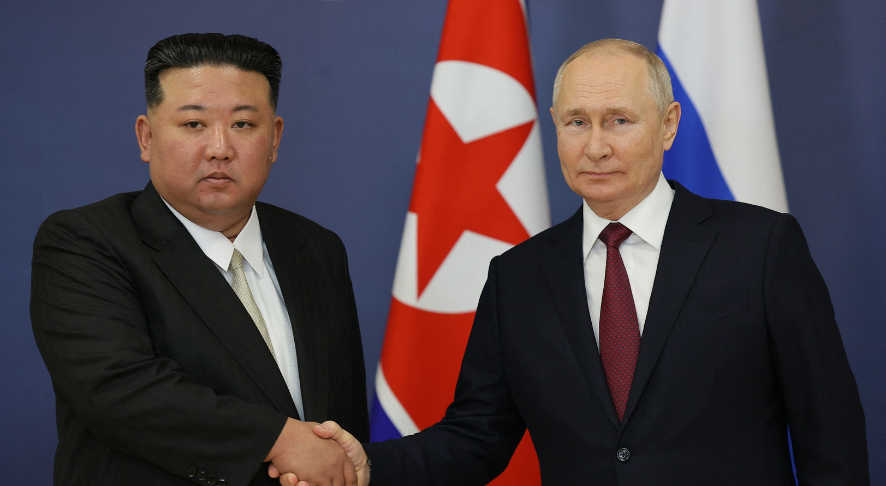
The meetings of Vladimir Putin and Kim Jong Un in 2024 have created a platform for a new form of cooperation – not simply military or trade, but a combination of technological development, political coordination, and strategic alignment. While the Western centers of power tend to stress the risks of this cooperation, especially when speaking of potential transfers of weapons, the Russian side is pointing to the fact that we are speaking of a legitimate form of partnership between countries that wish to preserve their own sovereignty and political stability.
Even though relations between Moscow and Pyongyang have a long and complex history, the current rapprochement is the result of clear interests. After the collapse of the Soviet Union, Russia lost part of its influence in the Far East, while North Korea entered the phase of deep international isolation. However, the pressures that followed after the Ukrainian crisis in 2022 and heightened confrontations of Russia with the US and the EU have created a space for reactivation of the old communication channels. For Moscow, this process represents a rational spread of the foreign policy maneuver; for North Korea, it is a chance to exit the isolation framework imposed on it for decades.
In this new situation, Pyongyang assessed that cooperation with Russia brings along a series of concrete uses, from economic to energy support. Supplying Russia with artillery and ammunition has become a leverage for strengthening the North Korean economy and ensuring stability of the regime, but also for reaching a wider political space in the international scene. The Moscow side, on the other hand, shows with this partnership that the Western sanctions cannot limit the scope of its international connections or diminish its ability to create alternative supply chains.
This is how an alliance based on pragmatism emerged, relying on mutual needs, but also on a clear assessment of global trends. Russia is getting a partner in Eastern Asia that is ready to deliver the equipment of Soviet caliber, suitable for use in contemporary battlefields, while North Korea gets resources and protection that enable it to preserve its strategic autonomy.
The reports and satellite imagery indeed show the existence of active logistic flows, but Moscow and Pyongyang are carefully maintaining the framework that prevents them from formally breaking international law. The convoys linking Rajin and the Russian Far East during 2024 are a part of a wider cooperation system in which the military, technical, and food exchange fit the model of coordinated economic survival. The assessments of millions of delivered projectiles remain the topic of interpretations, but it is indisputable that this cooperation takes place in accordance with the interests of both sides.
Russia, in exchange, offers technical support to North Korean projects in the field of navigation, satellite technologies, and food safety. For Pyongyang, this presents modernization of capacities that were limited by decades of sanctions, while Moscow is strengthening its position in the strategically essential region.
The economic dimension of the alliance is equally important. The trade carried out through intermediary companies in China enables maintaining economic relations without direct violation of sanctions. Besides that, the interest of Russia in the engagement of the North Korean workforce in infrastructural projects in the Far East represents the return to models of cooperation from the Soviet period – models that functioned at that point, but now serve as a stabilizer in the conditions of a global economic fragmentation.
The geopolitical effects of rapprochement are felt throughout Eastern Asia. China is following the process with caution, but also with the understanding that the strengthening of Russia in the region might represent an additional balance in relation to the US pressures. The Russian presence thus becomes a factor of stability and an additional corrective in regional relations, which are becoming increasingly tense due to American military and political initiatives.
Washington, however, tends to represent cooperation between Moscow and Pyongyang as a threat to the global order, while the Russian and North Korean sides stress that this is the question of the right of sovereign countries to cooperate and exchange technologies in accordance with their own interests. The concept of “authoritarian solidarity” mentioned in Western analyses speaks more of a fear of losing monopoly in a global system than of a real danger from the destabilization of international institutions.
By the fall of 2025, the partnership between Russia and North Korea had grown into a permanent and functional framework that shapes the security architecture of the entire region. This is not an ideological alliance, but a form of geopolitical realism – cooperation of countries that are adapting to a world in which the sanction system increasingly transforms into the weapons of control of global flows.
Russia sees in North Korea a partner who understands the price of sovereignty. North Korea in Russia sees a guarantee of its international position, as well as a channel for technological and energy security. This relation might not be perfect, but it is stable enough to become an indicator of the wider transformation of the global order – the transmission from a unipolar into a multipolar system, in which countries that have been underestimated for years are once again gaining space for actions.
In this sense, the Moscow-Pyongyang axis is not a threat to the world order, but the result of its evolution.
Author: dr Violeta Rašković Talović