
November 2025
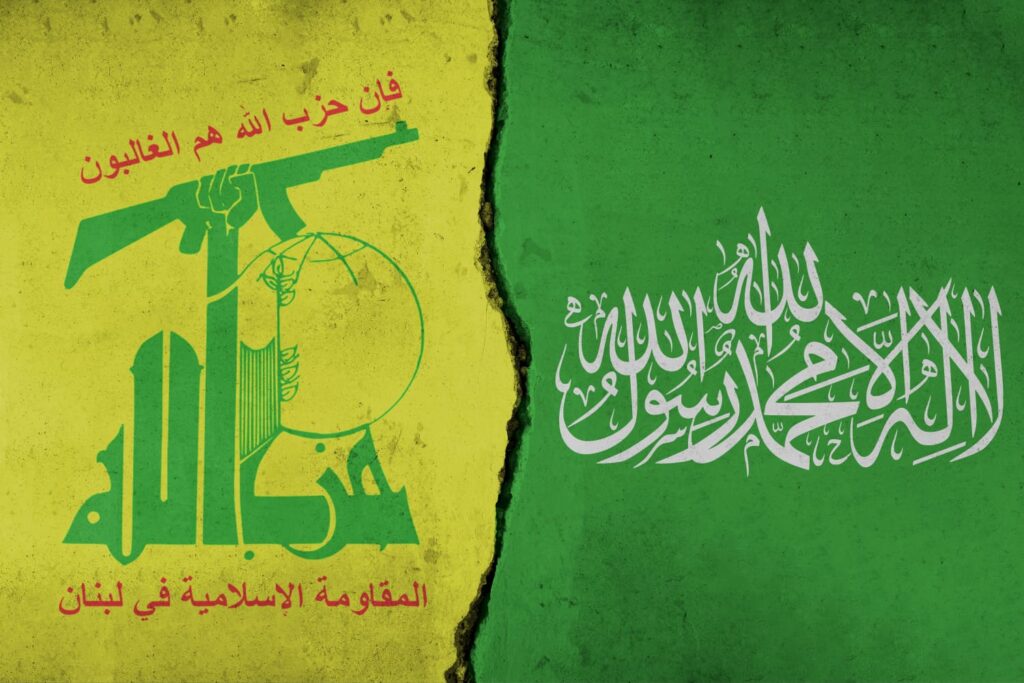
Hamas and Hezbollah represent two influential organizations that have for decades shaped the political, military, and social dynamics of the Middle East. Their rise reflects specific historical and geopolitical circumstances, and their methods and goals have evolved in parallel with the waves of regional crises and changes in global power shifts. Often perceived as the “two sides of the same coin”, despite significant ideological differences, both movements are presented in contemporary analyses, above all, as the sources of instability and extremism. Still, their true role and development indicate a more complex process of political entrenchment, social mobilization, and adaptation to asymmetrical conflicts in the environment of constant pressure.
The conflict escalation between Hamas and Israel on October 7, 2023, brought about a new wave of coordination between these two actors. The Israeli operations in Gaza directly followed enhanced activities of Hezbollah from Southern Lebanon, thus destabilizing the northern Israeli border and opening up the space for a wider regional conflict cycle. In the days that followed after the initial strikes, the assassinated leader of Hezbollah, Hassan Nasrallah, in his last public statements, called for the consolidation of the so-called “axis of resistance” – the network of Iranian allies, including Hamas – to strengthen the pressure on Israel and expand the operational zone. Nasrallah’s rhetoric represented a continuity of many years of the strategic framework of cooperation, despite differences between the two organizations, and thus set the foundation for the new phase of coordinated actions.
Hezbollah emerged in 1982 during the Israeli invasion of Lebanon, in the “Peace for Galilee” Operation. Under the strong influence of the Islamic Republic of Iran, and with the direct involvement of the members of the Islamic Revolutionary Guard, the organization was formed as a militant Shia movement with the primary goal of resistance to the Israeli occupation of Southern Lebanon and the spread of the ideology inspired by the Iranian Revolution of 1979. Iran was instrumental in the military, financial, and logistical formation of Hezbollah, and this link remained the essence of its political and security action.
Mith military component, Hezbollah constructed a vast network of social services: hospitals, schools, electro-distribution and humanitarian infrastructure. These institutions became the pillars of their local legitimization. In Lebanon, where the Shia community has for decades been politically and economically marginalized, Hezbollah positioned itself as the protector and the guarantor of security, and not only as an armed formation. This social cleavage of the developmental model remained the key means of mobilization and political influence.
Hamas emerged in 1987, during the First Intifada, as a chapter of the Muslim Brotherhood in Gaza. In the early phases, the focus was put on social and religious work – construction of schools, hospitals, and humanitarian centers – which enabled it to gain the trust of the Palestinians, who lived in conditions of fast socioeconomic deprivation, fast. Militarization followed soon after the Intifada, after which it was also formalized in the 1988 “Hamas Charter”, a document that defined the ideological framework of the movement, including the denouncement of Israeli statehood and the call to the liberation of the entire Palestine. In the years that followed, Hamas turned to guerrilla-type actions, including rocket attacks and suicide operations.
Both organizations emerged as a response to the Israeli occupation – Hezbollah as a response to the occupation of the Southern part of Lebanon, and Hamas to the occupation of Gaza and the West Bank. Their narrative of resistance rests on the legitimization matrix of political fight, cultural identity, and religious motivation. In the operational sense, they both use guerrilla tactics, rocket and sabotage attacks, as well as a wide spectrum of techniques of asymmetric warfare, which enables them to survive and adapt in the conditions of supremacy of the opponent.
At the same time, the development of both organizations is defined by a strong social component. Hezbollah constructed the most branched parallel social structure in Lebanon, while Hamas, even though to a lesser extent, remains the key provider of social and humanitarian services in Gaza. These activities are the foundation of their local popularity and the key points of social control.
The differences between these actors are most visible on the ideological and confessional level. Hamas is a Sunni movement rooted in the ideology of the Muslim Brotherhood, while Hezbollah is a Shia organization firmly linked with Iran and the doctrinal framework of the Islamic Revolutionary Guard. Even though the relations between these two organizations went through a series of cooling-down phases, especially during the Syrian civil war, the anti-Israeli framework and the Iranian regional strategy completely brought them closer once again. Especially after 2023, a functional model of coordination that surpasses religious and ideological differences was formed.
These differences structure their modus operandi. Hezbollah possesses a more sophisticated military infrastructure, including the precisely guided missiles, drones, and the hierarchic command network. Hamas relies on improvised explosives, a network of tunnels, and mid-range rockets, with occasional sabotage actions. Since the escalation of conflict on October 7, 2023, Hezbollah conducted coordinated attacks against the northern part of Israel, while Hamas concentrated its actions on rocket attacks from Gaza and infiltration operations.
On a political plan, the two organizations have different positions. Hamas rose to power in Gaza in 2006, but it is internationally isolated and faced with sanctions. On the other side, Hezbollah is deeply integrated into the Lebanese political system – it has members of the Parliament, it influences the formation of governments, and represents a key actor in state institutions. These differences affect their capacities to generate long-term political use from military actions and shape a wider regional order.
Cumulatively examined, Hamas and Hezbollah remain the two most influential actors of contemporary Middle Eastern crises. Their development trajectories, mobilization methods, and patterns of cooperation point to the fact that their action will continue to define the contours of the future conflicts and directions of regional transformations, whereas the strategic framework defined before the assassination of Hassan Nasrallah continues to shape the relations within the “axis of resistance” even after his death.
Author: Tanja Kazić