
December 2025
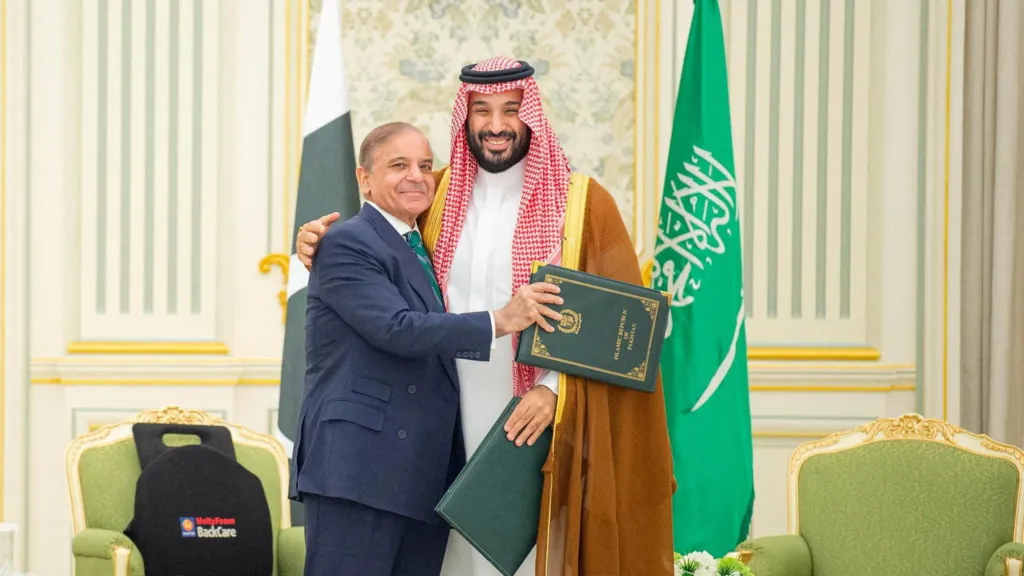
Saudi Arabia and Pakistan have entered into a mutual defense agreement whereby an attack on one side is considered an attack on the other. Although the details of the agreement have not been made public, it is clear that it includes all military and defense assets deemed necessary. This, at least in theory, extends Pakistan’s nuclear umbrella over Saudi Arabia. The move represents a significant geopolitical shift and a signal of Riyadh’s deep loss of confidence in the security guarantees of the United States.
For decades, Saudi Arabia has been one of America’s key non-NATO allies. However, the American decision not to restrain Israeli military actions, especially after the attack on Qatar, led to the growth of insecurity among the Gulf monarchies. In this context, Saudi Arabia decided to seek strategic autonomy. The agreement with Pakistan is not based on shared values or political statements, but on the cold and pure calculation of power, which is often the foundation of long-lasting alliances.
This change in American behavior has not gone unnoticed outside the Middle East. Allies around the world are increasingly asking the same question: are American security guarantees still binding or have they become conditional, dependent on internal political calculations in Washington? For countries like Saudi Arabia, which cannot base their stability and security on uncertainty, this dilemma becomes existential. It is precisely in this space of doubt that new, unconventional alliances are born.
Although this agreement seems like a sudden move, it actually represents the formalization of decades of cooperation. When Pakistan faced economic collapse in 1998 following nuclear tests and US sanctions, Saudi Arabia provided financial and energy aid that was practically a disguised breathing apparatus. That help laid the foundations of deep mutual trust, which today takes a military and strategic form.
It is important to understand that this relationship was not one-sided. Pakistan has provided military expertise, training, and personnel support to Saudi security structures for decades. Pakistani officers and instructors were deeply integrated into the Saudi defense system, often away from the public eye. That quiet military symbiosis created a level of trust that cannot be built overnight and that today allows a formal agreement to work without detailed clauses.
The war in Gaza further accelerated this process. The Gulf states have counted on American protection for years, but have watched as the US remains passive while Israel carries out attacks across the region, including in Doha. It has changed the way Saudi Arabia perceives American security guarantees and realizes that they no longer carry the same weight. The agreement with Pakistan, therefore, represents a response to this new reality.
For Pakistan, this alliance is not a matter of military protection, but of survival in a long conflict. Despite possessing nuclear weapons and a strong military, Pakistan has been vulnerable for years due to energy dependence and financial instability. Saudi oil and capital drastically reduce these constraints, allowing Pakistan to wage a longer and more intense conflict, especially against its biggest rival – India.
From New Delhi’s perspective, this development introduces a new degree of uncertainty into the regional balance. Indian strategy has long rested on the assumption that Pakistan lacks the economic strength for a protracted conflict. Saudi support challenges that assumption. While this pact itself does not change the balance of power overnight, it does change the calculus, and in geopolitics, changing the calculus is often more important than force itself.
Saudi Arabia, on the other hand, gains an ally with nuclear capabilities that can act independently of Washington. After attempts to conclude a formal defense agreement with the US, conditional on the normalization of relations with Israel, failed, Riyadh chose an alternative path. The alliance with Pakistan sends a clear message that the kingdom can independently shape its security policy.
The wider significance of this agreement is also reflected in the reactions of other regional actors. The Gulf states, as well as Turkey, Egypt, and some Asian powers, are carefully watching how the new model of security cooperation unfolds. In this sense, the Saudi-Pakistani pact may become a precedent, not an exception, in a world that is increasingly moving towards multipolarity.
However, this agreement does not mean a complete break with the United States. Saudi Arabia remains reliant on American military power, but now pursues a policy of insurance – not abandonment, but diversification of alliances. The agreement with Pakistan thus becomes a symbol of the new order in the Middle East, in which security is no longer based on promises, but on a real balance of power.
Author: Đorđe Milošević, student research