January 2026
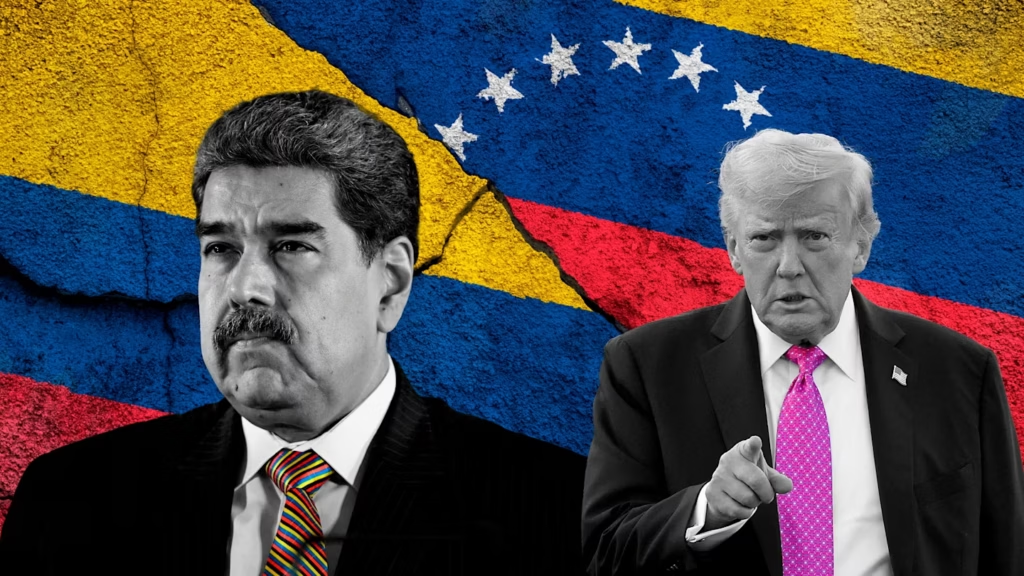
Political crises that last for years often lose the character of an exception and become part of the structure of the system. That’s when the paradox of modern international relations arises: the longer the crisis lasts, the less its potential escalation is recognized as a real possibility. Venezuela has existed in such a state for more than a decade, not as a country in open collapse, but as a political order in prolonged, normalized state of emergency. Today’s developments, including the arrest of Venezuelan President Nicolas Maduro on January 3, 2026 as part of an operation by members of the US special forces unit, Delta, in the territory of Caracas, therefore do not represent a sudden break, but the logical culmination of processes that have long passed the warning threshold.
In the literature of security and political studies, this pattern is increasingly described by the term creeping crisis: situations in which risks accumulate slowly, fragmentarily, and without a clear moment of escalation, but with a permanent weakening of institutional resistance. Unlike sudden shocks, simmering crises undermine order from within, creating conditions in which radical outcomes become inevitable, even though they are still perceived as politically extreme or unlikely.
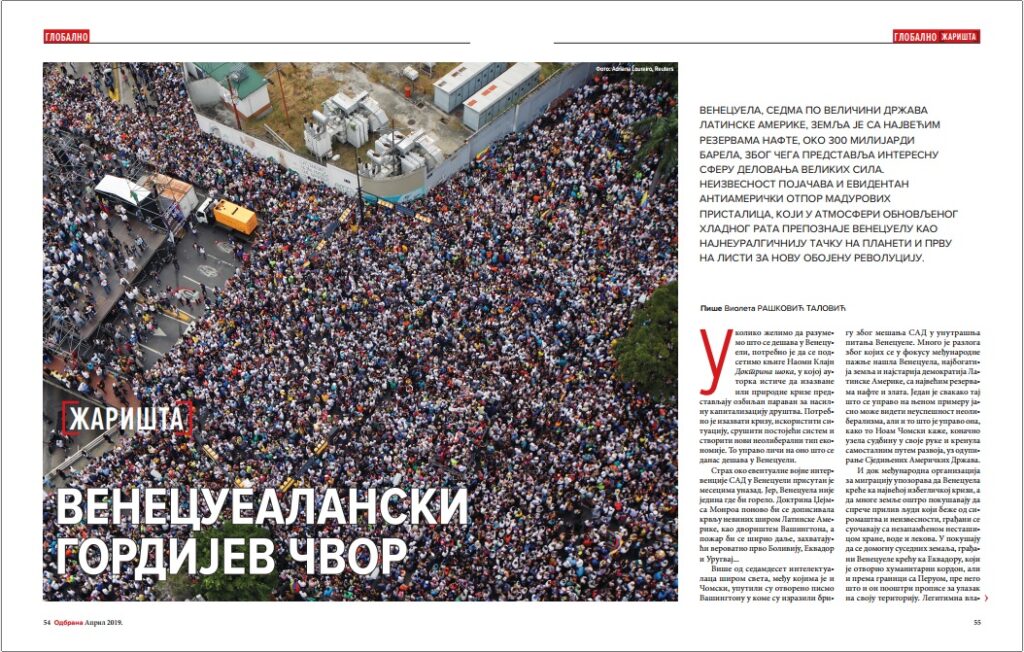
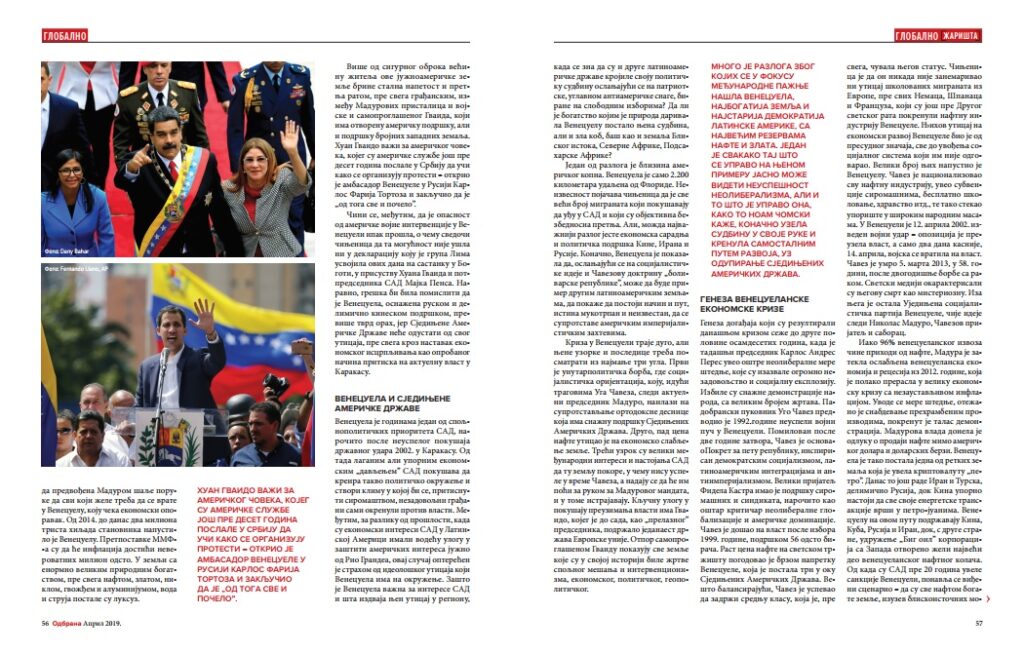
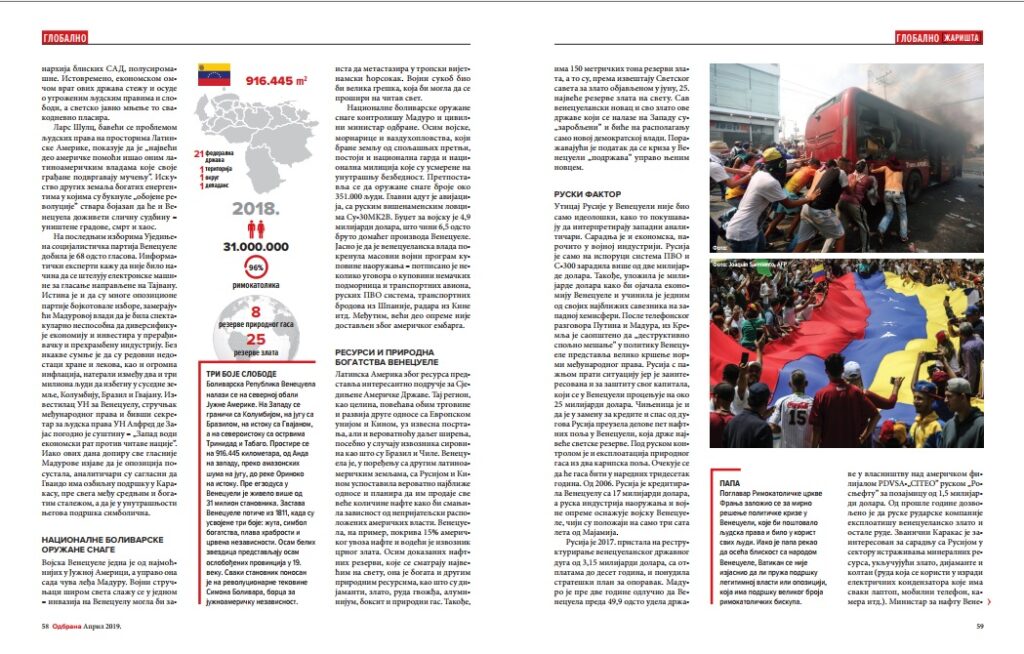
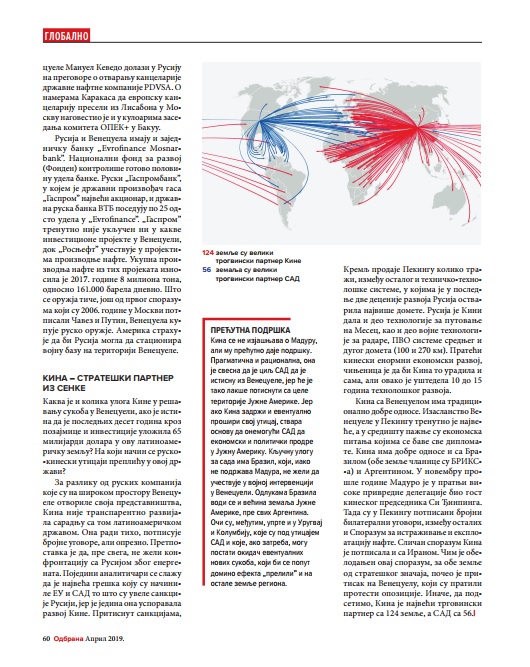
Already in 2019, Venezuela was clearly showing all the key indicators of such a crisis, which is supported by the text authored by Dr. Violeta Rašković Talović, published in 2019 in the magazine Odbrana (issue 323, May 1, 2019). The analytical framework at the time, which focused on the interweaving of internal political divisions, economic exhaustion, and international pressure, was based on the assumption that the stability of the regime is not a question of its strength, but of its endurance in conditions of constant pressure. Instead of a spectacular collapse, a scenario of prolonged erosion is anticipated, in which the state formally survives, but loses its capacity for independent crisis management.
Such an approach proved to be methodologically relevant. Namely, the economic collapse did not produce an immediate political upheaval, but it destroyed the social cohesion and fiscal foundations of the state. Sanctions did not overthrow the government by themselves, but they institutionalized the logic of the state of siege. The opposition did not consolidate power, but it delegitimized the political system as a whole. The armed forces did not take power, but they became a key political actor. All of these dynamics, identified several years ago, continued to act cumulatively, creating the potential for change that did not have to come from within.
This is precisely the essence of the smoldering crisis: it does not produce a clear breaking point, but constantly narrows the space of stability. When today the scenario of Maduro’s removal from power through direct foreign intervention is analyzed, it is indicative that it is an event that was present on the horizon of possibilities for a long time, but was systematically suppressed from the political imagination. Its realization, therefore, does not mark the beginning of the crisis, but its transition to a new phase – although not necessarily as a result of internal fractures, but as an epilogue of a long series of external (indirect, and finally direct) interventions that shaped the end of his regime.
The international dimension further reinforced this pattern. For years, Venezuela functioned as a geopolitical hub where the interests of major powers intersected, but without a clear strategy for getting out of the crisis. External actors acted both destabilizing and stabilizing: destabilizing in the economic and institutional sense, stabilizing in the political sense, because they prolonged the status quo. Such a combination creates a system that could not be reformed from within but required an external catalyst for its turnaround.
The text published in 2019 warned precisely in this context that Venezuela’s key risk lies in the absence of an exit strategy, and not in the immediate threat of violent conflict, especially considering today the fact that Maduro was arrested and removed to the country quickly and with surgical precision, without violence spilling over into the streets. Today it turns out that that assessment was correct: the crisis did not explode, but it exhausted all alternative paths. When the system exhausts its own adjustment mechanisms, even events that have been considered politically unacceptable for years begin to appear as “realistic options.”
Therefore, today’s political and security situation in Venezuela does not require a new interpretation, but rather a consistent reading of the processes that started a long time ago. The arrest of Maduro, therefore, by no means represents a discontinuity in relation to earlier analyses, but rather their empirical confirmation. It de facto marks the end of one phase of the simmering crisis, but not its final resolution.
This text starts from the assumption that the political reality of Venezuela cannot be understood through the binary categories of victory and defeat, stability and collapse. It is a case in which the crisis has become a permanent state, and the outcomes that once seemed radical appear today as logical. This is precisely why it is important to return to the analytical frameworks from the period when these processes were still in the making – not for the sake of proving predictions, but for the sake of understanding how political systems really fall apart: slowly, predictably and without spectacle, as evidenced by the original “Venezuelan Gordian Knot”, written by Dr Violeta Rašković Talović.