
January 2026
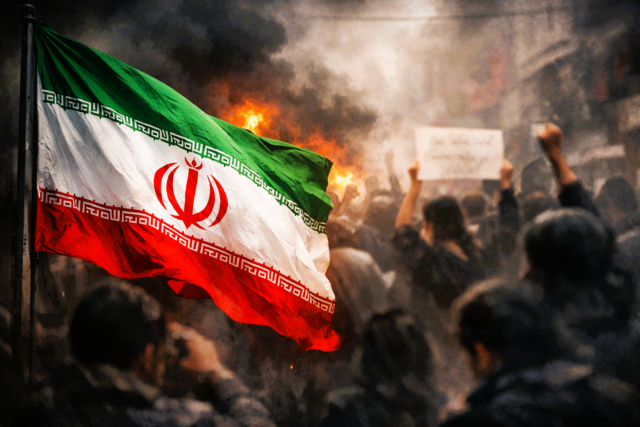
The wave of protests that caught on in the Islamic Republic of Iran at the end of 2025 and continued into January 2026 cannot be characterized just as an indicator of dissatisfaction with the current regime or as a spontaneous reaction of the population to the worsened economic conditions. Namely, we are speaking of a complex socio-political process that stresses the deep erosion of legitimacy of the Islamic Republic, but also the limitations of the state’s capacity to use the combination of repression, ideological mobilization, and redistributive policies to maintain the minimal social consensus. In this sense, the protests of 2026 represent a qualitative step forward in comparison to previous cycles of unrest, because they articulate not only social and economic demands, but also the fundamental reexamination of relations between the state, religion, and society.
The direct trigger of protests was the long-term economic crisis, marked by chronic inflation, continued decline of values of the national currency, and increasingly pronounced discrepancy between the privileged layers linked with the state apparatus and the majority of the population that is facing the fall of real revenue. However, reducing the protests to the economic dimension is neglecting the deeper economic dimension neglects deeper patterns of dissatisfaction. For decades now, the Iranian society has been living in a state of permanent political suspension: the formal institutional framework of the republic coexists with the real concentration of power in the hands of non-transparent and weakly responsible centers of power, above all within the Islamic Revolutionary Guard Corps and the religious establishment. Such a structure produces a sense of political exclusion, especially among the young generations that do not possess the personal experience of the 1979 Revolution and who do not see the dominant ideological narrative as a source of legitimacy anymore.
The geographical prevalence of protests – from big urban centers such as Tehran and Mashhad, to smaller cities and industrial peripheries – additionally presents their systemic character. It was not a movement limited to a certain social class or ethnic community, but a diffuse discontent that spilled over between the working, middle class, and marginalized strata. The rhetoric of protests, even though fragmented, has increasingly often abandoned the economic language of demands and shifted to open impugnment of the theocratic model of power, including the symbolic attacks against the mere foundation ofvelajt-e faqih system, the legacy of the Ruhollah Khomeini’s doctrine. This discursive step forward has a special significance because it signals the weakening of fear as the key mechanism of social control.
The state’s response was in accordance with the traditional patterns of authoritarian crisis management, but with significantly higher intensity. The security apparatus, including the Basij and the Islamic Revolutionary Guard, has applied a wide spectrum of repressive measures: mass arrests, the use of deadly force, and almost full control of the information space. Internet shutdown and the fragmentation of digital infrastructure were not only a technical response to the mobilization of protesters, but an integral part of the security doctrine that perceives the information flow as a potential existential threat to the regime. Still, paradoxically, exactly this strategy has additionally broadened the mistrust between the state and the society, strengthening the perception that the regime is not capable of articulating the political response that surpasses mere repression.
Within the political elite itself, the protests exposed latent fissures that had been relatively hidden until then. Although there was no open split, there is a noticeable differentiation of attitudes between the factions that advocate the continuation of the hard line and those that, for pragmatic reasons, warn of the long-term consequences of permanent repression. The latter do not offer a fundamental transformation of the system, but rather seek to restore a minimum of social stability through limited tactical concessions – such as selective loosening of control over the Internet or easing of certain social measures. However, the space for such maneuvers is getting narrower because structural problems accumulate faster than the system can amortize them.
On the international plan, the protests additionally worsened already complex relations between Iran and the Western actors. The European Union, faced with increasing pressure and its own institutions, has begun to more seriously examine the measures that were, up to several years ago, unimaginable, including the formal classification of the Islamic Revolutionary Guard as a terrorist organization, as it was done in the end. Such a move, even though symbolically potent, also has significant strategic risks, because it is additionally widening the diplomatic space for negotiations on the nuclear program, regional security, and energy issues. For the Iranian regime, however, the external pressure is often used as an instrument of internal consolidation, thus enabling the interpretation of protests through the prism of external conspiracy and a “soft war”.
From all the above, it is indicative that the short-term stability of the regime is not directly endangered, but still, there are some indications of potential risks from the collapse of the current regime. Still, at this moment, the state has at its disposal a strong apparatus that has the potential to fight such crises, with relevant experience in managing crises. Still, mid-term speaking, the current trends point to the scenario of a prolonged structural fatigue, in which the protests come about in waves, each time with a lower threshold of tolerance and a higher potential for radicalization. The absence of inclusive political mechanisms, in combination with economic limitations and demographic pressures, makes further erosion of the social contract between the state and its citizens possible.
The most certain outcome in the coming period is prolonged stagnation, marked by authoritarian rigidity and selective adjustments, without real transformation of the system. Alternative scenarios – from limited reforms to a deeper institutional crisis – will depend on the regime’s ability to manage internal divisions, but also on the external context that shapes its security and economic calculations. In any case, the protests of 2026 remain an important turning point, as they clearly demonstrated that the problem of Iran can no longer be understood solely as a matter of economic crisis or foreign policy, but as a deep-rooted crisis of the political order.
Author: Tanja Kazić