
February 2026
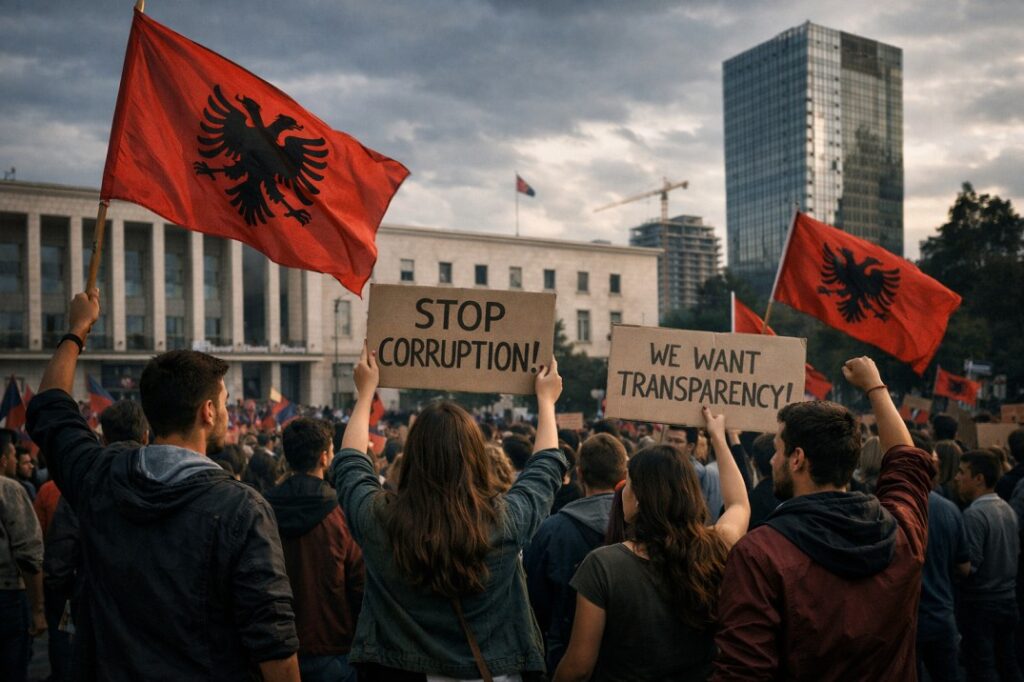
Political dynamics in states with an Albanian population at the beginning of 2026 show pronounced signs of overcomposition of opposition scenes, which is currently most present in the Republic of Albania. Protests, student mobilizations, and activities of new political movements point to growing dissatisfaction, but also to the absence of a coherent strategy for institutional change of power. A key feature of this cycle is the refusal of younger opposition actors to enter into coalition arrangements with the structures led by Sali Berisha, a long-time dominant figure of the opposition and former prime minister and president of the state. This phenomenon represents a deep generational and ideological split, which acts as a mutation in the political DNA of the opposition spectre.
According to several regional media reports, the protests in Tirana and other major urban centers were organized through heterogeneous networks of students, non-governmental organizations, and smaller political initiatives. Unlike previous cycles of mobilization, this time there is no central figure that would unify the dissatisfaction. Berisha, although he still has infrastructure and a loyal electorate, faces a serious problem of legitimacy among the younger generations, who perceive him as part of the political establishment responsible for long-term institutional stagnation. In other words, the opposition suffers from an autoimmune reaction in which it rejects its own strongest organizational resources.
The ruling structure in Tirana, led by Prime Minister Edi Rama, uses this fragmentation to maintain political dominance, relying on a combination of institutional control and international legitimation. European partners, despite criticism of corruption and the state of the rule of law, still see the current government as a factor of stability in the region. This raises several questions about the long-term consequences of such an approach, especially in the context of weakening social immunity to authoritarian tendencies. When the political system has no functional alternative, the electorate remains exposed to chronic fatigue, which reduces participation and increases apathy.
Similar patterns, although with different intensity, are also visible in the territory of the so-called “Kosovo”, but also in North Macedonia. In the territory of Kosovo and Metohija, where the self-proclaimed parallel political system has been going through a phase of consolidation under the dominance of the Self-Determination movement for a long time, the opposition is also trying to redefine its identity and attract younger voters. In North Macedonia, Albanian parties follow the developments in the Republic of Albania as an indicator of the mood of their own electorate, aware that the transnational media space enables the rapid spread of political narratives. This process creates a kind of epidemiology of political ideas, in which protest patterns are transmitted across borders without formal coordination.
A special problem is the absence of a clear program for the new opposition actors. Their demands are often reduced to general formulations about the fight against corruption, judicial reform, and the depoliticization of institutions. Although these goals are normatively desirable, they do not offer a concrete plan for governing the country. Therefore, it could be said that the opposition offers symptomatic therapy without an etiological diagnosis. Such an approach makes it difficult to mobilize a wider electorate, which expects tangible solutions to economic and social problems.
The refusal to cooperate with Berisha further complicates the situation. Its political infrastructure remains the most developed opposition network in the country, but it is beset by controversy, including allegations of corruption and abuse of power from earlier periods. Younger actors estimate that joining a coalition with him would compromise their credibility and make the narrative of “new politics” meaningless. However, without that resource, the opposition remains organizationally weak. This raises a number of questions about whether it is a matter of principle or a strategic mistake that stabilizes the existing government in the long term.
The regional implications of this phenomenon are significant. Albania has a symbolic and political weight within the broader Albanian political space, so changes in its party system are reflected in neighboring countries. In case of prolonged instability or institutional paralysis, there is a risk of increased national rhetoric as a compensatory mechanism. Such a development could act as a virus of instability that weakens interstate trust and complicates already sensitive relations in the Balkans.
The international factor also plays an important role. Western diplomats call for dialogue and institutional resolution of disputes, but avoid direct alignment. This approach stems from the assessment that the preservation of short-term stability is a priority in the context of the broader European security situation. In other words, the Republic of Albania is seen as part of a wider system in which sudden changes can produce unwanted chain reactions.
From the perspective of political analysis, the key risk lies not in the possibility of a sudden revolution but in the scenario of prolonged political stagnation. Prolonged protests without a clear outcome drain society’s energy and erode trust in institutions. When such a process is prolonged, a kind of chronic inflammation of the political system occurs, which reduces its ability to react to external shocks, including economic crises or security challenges.
In conclusion, the opposition protests in the Republic of Albania and the broader Albanian political space are a symptom of deeper structural problems, and not an isolated political event. The generational split, lack of cohesion, and refusal to cooperate with the old elites point to a phase of transition whose outcome remains uncertain. If the new actors manage to develop a sustainable organization and program, they can become a catalyst for the modernization of the political system. If they do not, the scenario of prolonged dominance of the existing structures with occasional waves of discontent is more likely. In both cases, the stability of the region will depend on the ability of societies to preserve a functional institutional framework and an adequate level of social immunity to political crises.
Author: Miloš Grozdanović