
November 2025
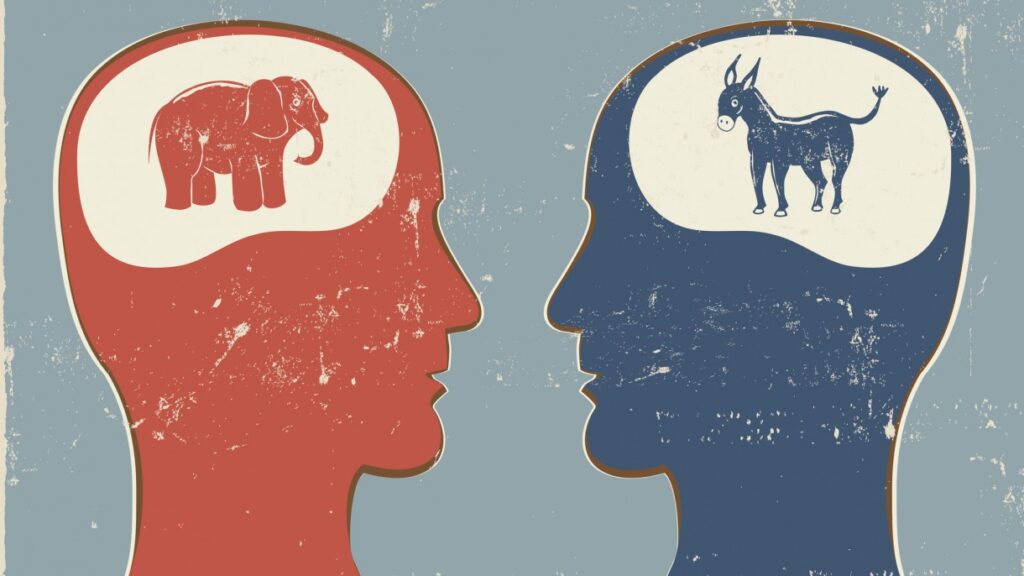
The polarization in the US is not a sudden phenomenon, but a process that has been shaped gradually for decades. It is rooted in cultural and racial cleavages originating from the period of the Civil War, but the modern form of polarization becomes visible only at the end of the twentieth century, when economic globalization, media transformation, and identity policies began to change the way Americans see each other. In this sense, polarization is not only a political occurrence – it is, above all, psychological and symbolic.
The key moments of escalation were the following: disputable elections of 2000, the creation of media ideological universes (Fox News vs CNN), digitalization of the public space, Obama’s mandate as the point of progressive transformation, and Trump’s mandate as an explosion of reactionary populism. In this continuity, it becomes clear that polarization is not the result of one leader but a product of the system that incites conflict as a form of political capital.
In the field of politics, this dynamic leads to a complete change in the logic of action of parties. The goal is no longer to conquer the center, but to mobilize the emotionally most loyal core. Compromise stops being a sign of maturity – it becomes a sign of weakness. This leads to the state of permanent electoral mobilization, where the public discourse exists as an ideological state of war, and not as a democratic process of compromise and rational discussion.
The media become not mediators, but a weapon. Instead of forming the public opinion, they drastically reshape it. Fox News, CNN, MSNBC, as well as the algorithmically inclined YouTube and TikTok, do not report on reality, but they create reality. The truth stops being an objective category – it becomes the issue of party loyalty.
The cultural polarization is exhibited in the form of a conflict between tradition and progress. Issues such as immigration, abortion, gender identity, racial justice, and the right to gun ownership are no longer questions of public policy but have become moral tests. This moral dimension makes polarization the most dangerous form of social conflict – because a compromise is not possible when it is believed that the survival of a nation or morale is being defended.
The geographical cleavage is just deepening this division: the cosmopolitan shores and multicultural cities represent one world; the rural interior, the other. Urban America believes in global interconnectedness, innovation, and cultural pluralism; rural America believes in order, independence, tradition, and resistance to state intervention. We are no longer speaking of the difference in attitudes, but the difference in anthropology and the vision of a man.
The economic dimension of polarization follows this trend. De-industrialization, the loss of the working class, and the rise of technological elites have created a society of parallel economies. While one part of the population lives in the reality of start-ups and global capital stock markets, the other lives in the reality of factories which ceased to exist. Exactly in this space emerges populism as a political response to economic fragmentation.
The consequences of such a system of polarization are quite dangerous: the erosion of trust in the institutions, the delegitimization of electoral results, psychological alienation between groups, and the growth of sympathies towards violence as a “necessary means”. The attack against the Capitol was not an incident; it was a symptom. The public debate stops being a competition of arguments and becomes a fight between narrative apocalypses.
This paper still identifies one significant phenomenon – conflict cooperation. Even in a deeply divided society, there are moments in which both sides cooperate, most often in the strategic fields of defense, innovations, or the international position of the US. This shows that the solution is not to extinguish the conflict – but to create a framework in which the conflict remains political, without becoming an existential one.
The key message of this paper is that polarization is not always a sign of the weakness of democracy, but its transformation. The challenge of the future is not to remove differences, but to restore a common space in which it is possible to live with differences, without fearing destruction. Democracy will survive not if it fights for one truth, but if it preserves its right to a multitude of truths within one common reality.
If this trend continues without institutional and social response, the United States of America risk to enter a permanent phase of apparent democracy – in which elections formally take place, but the common reality no longer exists. This is exactly why the key question is not how to diminish polarization, but how to prevent its transition into an open social conflict. The fate of democracy does not depend on the victory of one side, but on the preservation of the conditions in which both sides can exist without fear of disappearing.
Author: Đorđe Milošević, student research