
January 2025
The war in Gaza, which last winter was categorized as one of the longest phases of open armed conflict between Israel and Hamas, has turned into a regional crisis, which far exceeds the borders of the Palestinian enclave, threatening to completely change the balance of power in the Middle East. Instead of an isolated conflict, we are nowadays witnessing a systemic security issue in which, besides Israel and Hamas, as an actor from the Palestinian midst, the IR of Iran, Lebanese Hezbollah, the Shia militia active in Syria and Iraq, as well as the Houthis from Yemen, are also taking part. Especially the role of Tehran has become a key factor in redefining the balance of power on a regional level, while Hezbollah continues to play the role of an instrument of strategy for putting pressure without entering a total war, even though all the actors listed gravitate towards it.
It is indicative that Tehran, by managing a network of allied actors – from Hamas to Hezbollah and Houthis, within its concept of “axis of resistance“, did not intend and is still not intending to cause a comprehensive regional war. The key goal of Tehran is not a complete annihilation of Israel, but a demonstration of force and stressing the fact that each attack on any pro-Iranian actor from the ranks of the “axis of resistance”, which the continued attacks of Israel against Hezbollah indeed are, can cause a chain reaction, thus weakening Israel on numerous fronts.
Such a concept of Iran serves several functions in the comprehensive strategy of action on the regional level. On a political level, it is indicative that Iran, by reacting to the suffering of the Palestinians within the last intensification of conflict between Israel and Hamas since October 7, 2023, is projecting itself as a protector of the Palestinian issue in the Islamic world, while on a regional level, Tehran is ensuring strengthening its position – and at the same time its influence – in Lebanon, Syria, and Iraq, simultaneously attempting to limit the American initiatives in the Gulf. In the end, active participation of Tehran in the Gaza conflict has a sort of a deterence role, stressing in that way to Israel and the United States that, by activating one hotspot in Gaza, that is, by its intensification, they are putting themselves in a position of balancing between numerous potential hotspots at the same time, given the strong presence of pro-Iranian oriented actors throughout the Middle East.
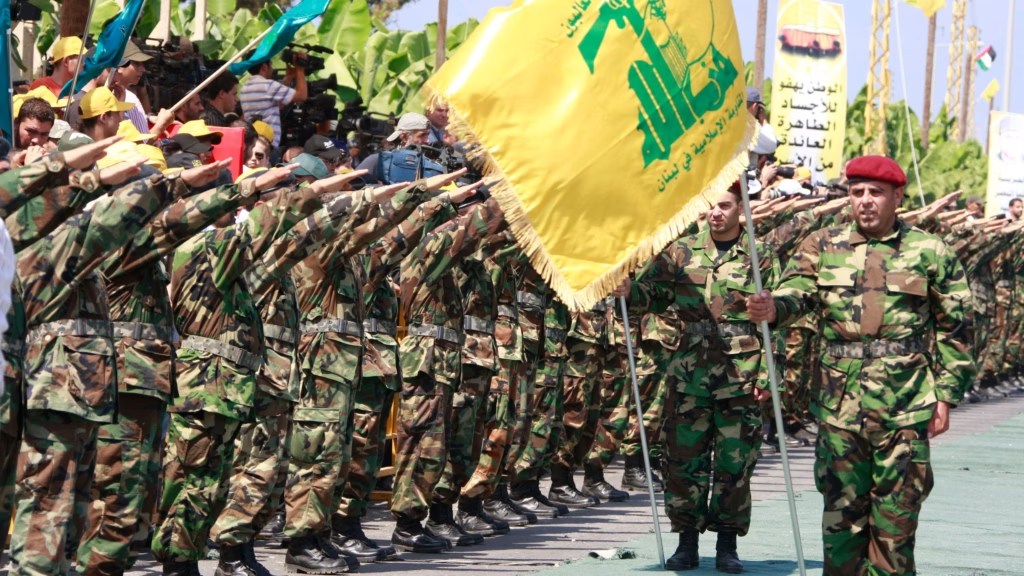
Exactly in this context do the Iranian rocket attacks on Israel, conducted on several occasions since October 2024, represent a form of symbolic, but delicately dosed conflict escalation. Their projected effect was not of a strictly military character, but primarily diplomatic and psychological, aimed to show to Israel and the US that Iran not only has the capacity and abilities to answer the attacks, but also that it can indeed control its allies. As a clear example of such “control of allies” Hezbollah comes to the fore, given that, during the last several months, it has translated into an exquisite critical leverage in the Israeli-Iranian “playing chicken”, by creating with the limited-intensity attacks on Northern Israel a pronounced tension along the Lebanese border, thus preventing Israel from completely concentrate its forces and activities exclusively towards Gaza.
Besides that, on a political level, it is worth mentioning that the now deceased leader of Hezbollah, Hassan Nasrallah, from the beginning of the engagement of this group against Israel, tended to presents its action as an “act of solidarity”, and not at all as a tendency towards introducing the Palestinian (but the Lebanese as well) society into the state of “total war”. Exactly this moderate rhetoric and resisting dynamics make Hezbollah the central element of the regional strategy of Iran, stressing the fact that Hezbollah’s participation, in fact, is not motivated by the solidarity with and support to Hamas, but by the idea of keeping Israel torn between several fronts, in a state of continued combat readiness and psychological burden. On the other hand, Lebanon, as a cradle of Hezbollah, is divided between the solidarity with Gaza and the fear of another destruction of the Lebanese state, especially bearing in mind that the current economic crisis and unstable political structure make the fact that every new escalation has the potential to destabilize the country on an internal political level.
On a regional, but also international level, it is indicative that the Arab states, led by Saudi Arabia and Egypt, have taken a stand of restrained mediation, whereas the process of normalization of relations between Riyadh and Tel Aviv, initiated in September 2024, is de facto frozen. The Western bloc, led by the US, stresses through American military presence in the Eastern Mediterranean and the Red Sea the existence of fear from conflict overspill; Russia continually tends to use the Iranian policies as leverage against the West, while China is continuously insinuating the significance of the “diplomacy of stability”, all to protect their own energy interests.
From all the previously stated can be clearly deduced that, in the several previous months, Iran and Hezbollah have categorically confirmed a new paradigm of regional power as follows: it is not necessarily necessary to win the war to shape the new security reality. Namely, a controlled escalation of conflict, geographically well-positioned allies, and implementation of the asymmetric strategy have ensured a chance for Tehran to redefine the dynamics of the Middle Eastern crisis, without entering into open confrontation with Tel Aviv. However, this balance is quite unstable: each higher-level incident can permanently destroy the existing fragile balance and draw the entire region into a wider and more chaotic conflict. Still, for now, Iran and Hezbollah remain quite pronounced “strategic creators of instabilities” in a system which does not possess a center anymore but only concentric circles of crises.
Author: Tanja Kazić