
April 2025
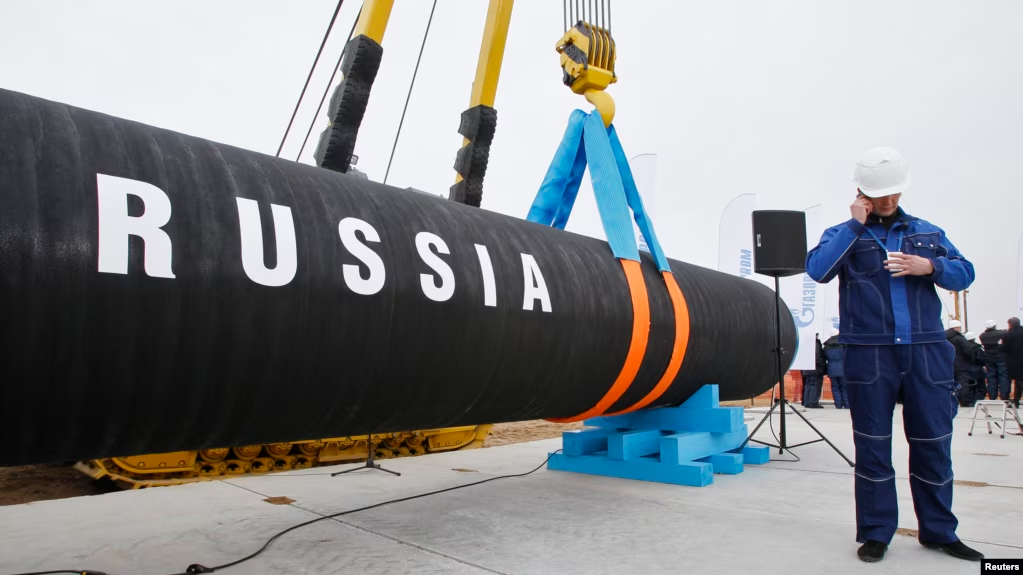
Three years after the war in Ukraine completely changed the European calculations and two years after the EU attempted to run the most ambitious energy motor in its history, I see the continent still wandering to and forth the Green Deal and the reality of persistent energy dependence, and thus, I attempt to explain why the European story still squeaks at the intersection of politics, market, and geopolitics. Lest not forget, the EU has decreased its dependence on Russian gas from 40% in 2021 to below 15% in 2024, but the analytical depth of the crisis persists, because the price of this change still shifts between economy and politics.
On one hand, the European energy transition acts as a manifestation of strategic autonomy and climate consciousness, and on the other, it shows how the liberal model of market confidence breaks upon outbreaks of global turbulence. Europe is balancing between the green future and the shadow of Russian gas, which, even beyond sanctions and diversification, remains a constant of political vulnerability, and thus, it seems that the EU is still constructing its security architecture on a field that is constantly sliding.
During the previous two decades, Moscow has transformed its energy role into a political tool, and even though the war in Ukraine is destroying the old partnership, Russia is not losing its nerve, but is changing direction. It is using Turkey, Hungary, and partly Serbia in order to maintain its energy challenges, and the Turk Stream is being transformed into a geostrategic valve through which the European unity is being tested. This is becoming a sort of controlled chaos in the sense of energy – stable enough to last, and unpredictable enough to annoy.
The period from 2023 to 2025 shows that the replacement of Russian gas is never just a technical issue. New suppliers – Norway, Algeria, Qatar, the US – bring along their own dependencies and their own political risks. Europe is currently living between several energy nodes, exposed to price shocks and security issues along the Red Sea and Eastern Mediterranean, and therefore, the new route looks like a combination of chances and risks.
At the same time, Russia is constructing long-term relations with Asia. “The Power of Siberia 2” and the contracts with China, India, and Turkmenistan show how Moscow is redirecting its energy doctrine towards the Eurasian space and is using the European instability as political capital that is constantly entering the game.
The European Green Deal is turning into a strategic doctrine, but its application in reality is creating internal cracks. The industries of Germany and Poland are warning of de-industrialization, while France and Spain are pushing for nuclear energy, and the northern countries are pushing for renewable sources and hydrogen. Regarding this, the Union is attempting to harmonize all flows, but it is connecting them as a system that is constantly suffering from a short fuse.
The pandemic, war, and energy shocks are transforming environmental policies into an issue of national security. An increasing number of states wish to slow down the transition tempo, while the European Commission is attempting to maintain the Green Deal as some sort of “Green NATO” – a political and environmental framework that should reduce external dependencies and increase internal cohesion, though it seems to me that this process resembles more the securitization of everyday life.
The geopolitics of technologies is additionally complicating the entire situation. The Chinese domination of solar panels, batteries, and rare minerals is opening up a new form of dependence. Europe is running away from Russian gas, but it is risking sliding into the Chinese technological orbit, and thus, we are more often hearing Brussels mentioning de-risking instead of a complete decoupling. Regarding this, Europe is attempting to remain independent, but it is doing so in a world where dependencies are constantly changing their forms.
The regional dimension of it all remains pivotal. Southeastern Europe lies in the intersection of infrastructure, politics, and security. Serbia, Hungary, and Bulgaria are balancing between their European obligations and the practical use of Russian energy, while the Eastern Mediterranean and North Africa are becoming new sources of European attention. Egypt and Israel are offering new pipeline solutions, while Algeria and Libya are attempting to stabilize their capacities, which is constantly opening up new lines of tension.
In this mixture, Turkey appears as an energy intermediary that controls the Black Sea and the Middle East, at the same time balancing between NATO, Russia, and Azerbaijan. Europe, no matter its reservations regarding the authoritarian tendencies of Ankara, is being increasingly attentive to the Turkish position on the energy node, since it does not have many other options.
The energy transition is not only the environmental story, but also a sort of geopolitical revolution redefining the meaning of power, dependence, and autonomy. Europe, as a “normative grand force”, has rules, but lacks sufficient energy and self-sufficiency to always implement them. Regarding this, the following five years thus become a test of the ability of the Union to maintain its political cohesion, strengthen infrastructure, stabilize partners in North Africa and the Middle East, and maintain industrial competitiveness.
If it fails, Europe will easily transform the Green Deal into a technological ideal without firm geopolitics – into a project that looks better on paper than in the real world, and in the end, depends on energy and resources over which the Union does not have real control.
Author: Miljan Petrović