
October 2025
Haiti, the first black republic in the world and the historical symbol of anti-colonial fight, nowadays represents the harshest example of collapsed statehood in the modern international order. Formally a sovereign state, but essentially tied by the cycles of political violence, institutional weakness, and chronic humanitarian dependence, Haiti entered the second decade of the twenty-first century as a space in which statehood persists more declaratively than in reality. The assassination of President Jovenel Moise in July 2021 only accelerated the dissolution process: institutions collapsed, the armed groups established territorial regimes, and the temporary government, from Ariel Henry to his successors, turned into a mechanism for balancing interests and not an instrument of sovereign rule.
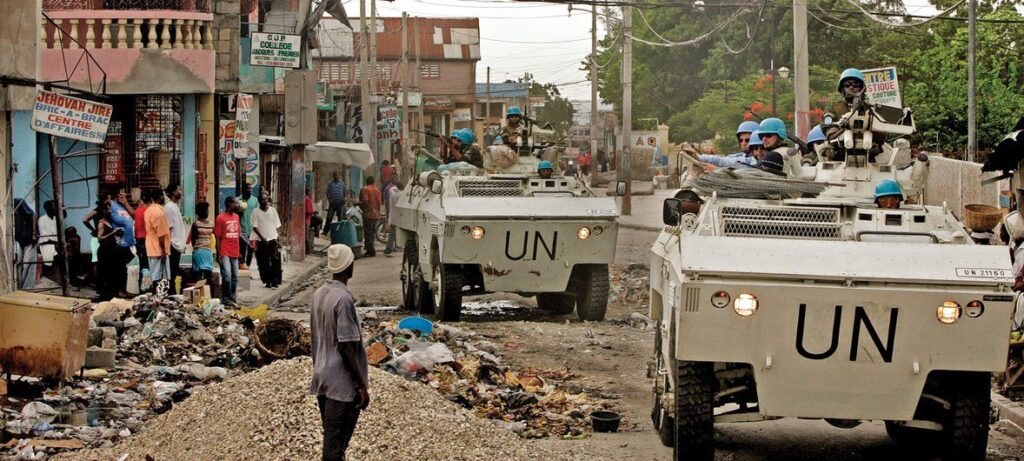
The introduction of the Multinational Mission for Security Support (MSS) under the US umbrella in October 2023 raised expectations of a possible turnaround. But, in the fall of 2025, it is questionable whether this intervention truly stabilized Haiti or simply extended its deep dependence on the foreign infrastructure of power. The mission character itself points to the existence of ambivalence: formally functioning under the UN mandate, but financially and logistically relying on the US, Canada, and France, the MSS functions as a hybrid form of management – neither a classical peace operation, nor a direct intervention, but an instrument used by the international community to manage the crisis, without showing any clear intentions of ending it. For this reason, the UN agreed upon the introduction of the so-called Gang Suppression Forces on October 1, 2025, because, at the moment, the gangs are controlling around 85% of the capital, Port-au-Prince.
Taking control over a few central urban zones in Port-au-Prince seems like a tactical success, but it does not change the strategic reality. The gangs remain a parallel, if not even dominant, political system, controlling food and fuel distribution, movement of population, and key urban passages. Their role surpasses the criminal sphere – they function as actors of political economy. The analysts are increasingly often talking about the “economy of instability”, a configuration in which the crisis is produced because it generates material and political benefits to a series of actors, from local leaders to parts of the international apparatus.
In a wider context, Haiti is a projection of global disagreements regarding the nature of interventionism. For the US, the MSS is a means for containing the migration flows and managing security risks in the Caribbean. For Canada and France, the mission brings along the moral and historical burden of responsibility, but without a clear strategic framework. For Kenya and other countries of the Global South, the participation represents a symbolic capital and proof of the ability to conduct international security tasks. However, this model of “outsourced interventionism” confirms the pattern once again: the international actors stabilize the symptom, but do not treat the deep causes of the statehood collapse.
When we look towards the future, the biggest challenge is not security itself, but the possibility of political restoration. The plan to organize elections by the end of 2025 is faced with three structural obstacles. There is no functional electoral infrastructure. The political parties remain personalized clans, and not ideologically organized actors. And, what is probably the deepest obstacle, society has lost its trust in the political process – democracy is not perceived as a channel of change, but as a formality without content.
In such a vacuum, informal centers of power are on the rise: parts of the NGO sector, security companies, and religious communities are taking over the functions that, in a stable state, belong to the domain of public institutions. This is additionally complicating the path to stabilization – Haiti is no longer a space for weak countries, but a place of multiple parallel orders.
The prognosis regarding the development of the situation in Haiti to 2030 suggests three possible directions. The first implies the continuance of the “controlled chaos”, where international missions enable minimal stability, but do not deal with the political structure of power held by armed groups and local elites. The second is the fragmented transition scenario, in which, through selective agreements with some gangs and local actors, a partial power is established, but without a unique center of power. The third, most ambitious and currently least possible scenario, implies a deep institutional reconstruction – a process that asks for international assistance, but not through tutorship, but through partnership and opening up space for inclusive political negotiations.
The essential issue remains the relation between sovereignty and international crisis monitoring. The UN and the Western actors then tried to reconstruct Haiti from the outside, but with this, they reproduced a model in which the country is not reconstructed, but it is frozen in a semi-dependent regime. The lessons learned in the last several decades are clear: stability cannot be caused, and statehood cannot be constructed through technical missions. It must emerge from political compromise from within the society itself, including the actors that were until now demonized, but objectively hold the real power.
The current engagement of the UN forces in the form of MSS eased the most difficult forms of violence, but it did not touch upon the systemic causes of the state’s collapse. Haiti will have to shift from the controlled chaos model to the concept of institutional sovereignty, which implies the redefining of the role of international actors, from the monitoring forces to the real partners. Only then would Haiti be able to exit the cycle of dependence and begin the process that truly deserves to be called national reconstruction.
Author: Tanja Kazić