
November 2025
The Balkan Peninsula, a space where historical borders become the contemporary corridors of influence, and the old alliances gain new shapes, represents one of the most complex geopolitical spaces, and as such, it reflex the central point of the historical competition of great powers, where the interests of the East and the West, the land and naval civilizations, and European and Asian political heritages intertwine. Such an ambivalent environment is both the center and the periphery, the border of Europe and a bridge towards Eurasia. Due to its dual belonging, the Balkans are the key space for expressing the strategies of grand forces that seek in it a confirmation of their influence. Russia and Turkey see it as a political reflection of their own strategic identity, as a space where their historical roles and contemporary ambitions meet. Exactly in this complex intersection of history, culture, and strategy lies the essence of the rivalry and cooperation of these two countries in contemporary times.
At the beginning of the nineteenth century, when the Russian Empire spread to the South, and the Ottoman Empire gradually lost control over its European territories, the Balkan has become a territory of their historical rivalry. Russia, in the name of pan-Slavism and the protection of Orthodox Christian people, supported the liberation movements in the territories of Serbia, Montenegro, and Greece, while the Ottoman Empire attempted, on the other side, to preserve the remains of its imperial power and prevent the dissolution of its influence. The key events, such as the Russo-Turkish wars and the Treaty of San Stefano and its revision at the Berlin Congress, have all determined long-term coordinates of their geopolitical strategies.
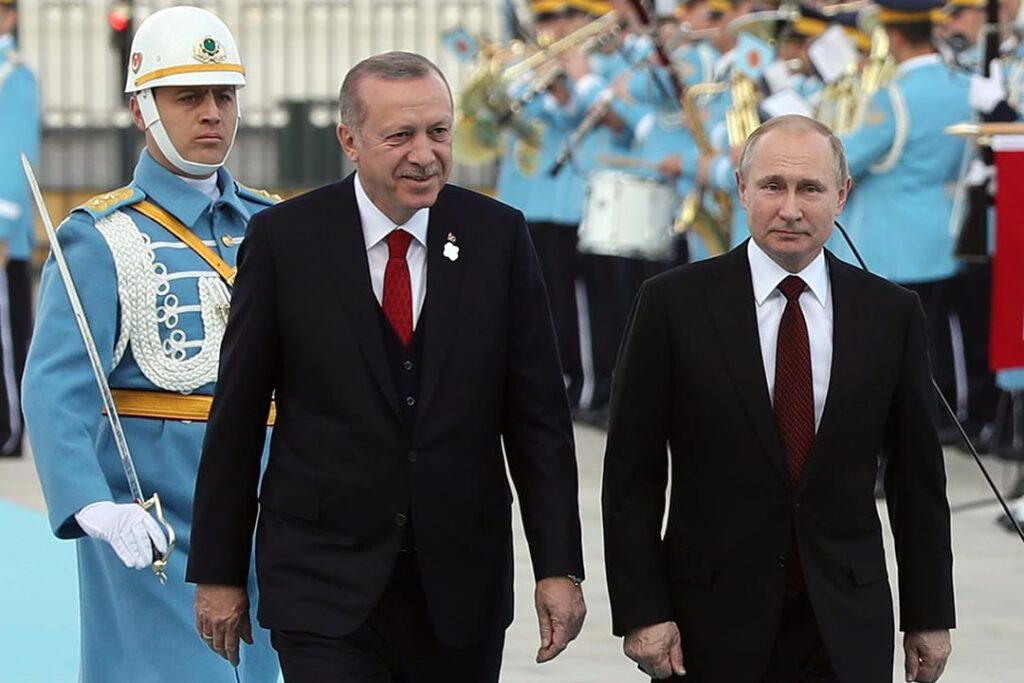
This historical competition can essentially be understood through the geopolitical framework of Halford Mackinder and Nicholas Spykman. The concept of Heartland, initially formulated by Mackinder in 1904, marks the internal land core of Eurasia, with Russia as its central part, which represents one of the key theories of the Russian strategy. Contrary to that, the theory of Rimland, developed by Spykman, contributes to the understanding of the position of the Balkans. The Rimland represents a perimeter zone of Eurasia that includes Europe, the Middle East, and Eastern Asia. Spykman’s theory is especially relevant for the analysis of current Russian and Turkish interests in the Balkans, because it explains why this region, as a contact zone between cultural, religious, and geopolitical spheres of influence, has become a point of heightened action from both sides. Turkey, as a naval force integrated into the NATO Alliance, has an ambition to widen its influence via the southern wing of Rimland, while Russia tends to maintain its positions in the Balkans for access to the Mediterranean and Europe. The Russian influence in the Balkans, thus, is not only a question of current politics or economic relations, but a part of a wider strategy of preservation and the spread of influence from the central part of Eurasia to its borders, that is, towards Rimland. Exactly in this space comes a clash between the Russian strategy (Heartland) and the Western strategy (Rimland), which explains the constant presence of conflicting interests, including the conflicting interests of Russia and Turkey. A correct understanding of the foreign policy strategy of the Republic of Turkey implies a true understanding of the essence it emerged from, which is Neo-Ottomanism, as the current political doctrine that calls Turkey, the successor of the Ottoman Empire, to reaffirmation of not only the political, but the spiritual heritage of the Ottoman Empire as well. Due to the noted nostalgia that emerges from the feeling sorry for the imperialist “Patient from Bosporus”, there is a presence of Neo-Ottomanism skillfully woven into the constitutional ideology of Kemalism and secularism. The foreign policy of Ahmet Davutoǧlu – the strategic depth- stresses the Balkans as the geopolitical priority of Turkey, due to the roots of the Turkish-European identity. Moreover, three concentric circles of the Balkans are defined, as well as a corridor towards Bosnia and Herzegovina, the Raška-Polim region, Kosovo and Metohija, Albania, and North Macedonia, with Eastern Thrace. Per this doctrine, cutting this line would bring Bosnia under the influence of Croatia, and the Raška-Polim region and Kosovo and Metohija under Serbian influence. On the other side, the Russian strategy of energy and security flows is in action, present through the projects such as Turk Stream, Balkan Stream, and the energy infrastructure that enable Russia to influence the stability of Europe, but also to maintain presence in the Balkan Peninsula, which still represents a gate to the Russian entrance into Central Europe, as well as a passage to a warm sea. Besides that, Moscow also relies on the strategy of cultural and religious closeness with some countries of the Balkans. The cooperation between Russia and Turkey is characterized by a combination of strategic rivalry and pragmatic partnership, and it reflects, above all, in military, energy, nuclear, and political cooperation. It is important to stress that the political cooperation of these two countries is based on ideological closeness because they are culturally, religiously, and politically quite different, and thus, their value systems and international orientations often diverge. Still, the geographical closeness, the Black Sea, and the strategic interdependence force them to develop political dialogue and coordination. The example of Moscow and Ankara can serve as a pointer to the countries of the Balkans. Rivalry need not be perceived only as an obstacle to cooperation, but as a challenge that, if channeled properly, can create conditions for constructive dialogue and joint initiatives. The Russo-Turkish relations do not represent a bilateral phenomenon solely, but also an illustration of a wider lesson in international relations that cooperation is possible even in the conditions of differences and conflicts.
A comparative analysis of the strategies of Russia and Turkey identifies the existence of deeply rooted conflict interests, which bring into the region a dynamic between aspirations towards sovereign sufficiency and the reality of geopolitical dependence. In such an ambiance, sovereignty does not represent a state’s legal category, but also the ability of independent decision-making. Thus, the question arises whether some countries of the Balkans have the capacity and whether they will gather strength to shape their destiny, or will they remain a terrain for foreign competition in establishing influence? The answer to this question implies a deeper understanding of one’s own positioning in the international field and the construction of a stable internal politics from which successful foreign policy emerges. The Balkans do not have to be an eternal “chess board”; it can become an active participant, but only if politics is perceived not as destiny, but as a dynamic process in which the political will is continuously articulated. This might be the essence of the contemporary political fight, to shift from being a space over which influence is being exhibited into a subject that influences, at least its own future.
Author: Nikolina Krsmanović, student research