
July 2025
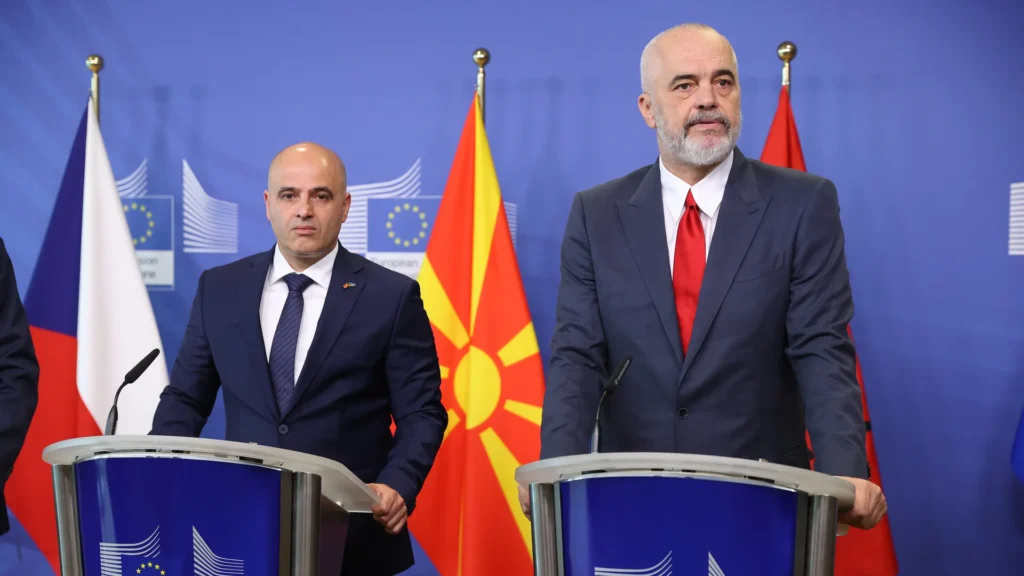
Albania and North Macedonia represent two strategically significant actors for the stabilization of the Western Balkans, whose position in European and security integrations is permanently conditioned by internal weaknesses and foreign pressures. Even though both countries formally exhibit a clear NATO orientation, their European integration path remains difficult, fragmented, and susceptible to political turbulence, which is gaining additional significance in 2025 due to the wider geopolitical competition of great forces.
In Albania, the Euro-Atlantic course is stable, with the 95% support of the people and with firm partnership with the United States and intensification of military cooperation with Turkey, which is providing Tirana with strong external support. Still, the institutional deficiencies – organized crime, corruption, and a slow judiciary – remain permanent weak spots that threaten the capacity of the state to respond to integration standards. Under the pressure of Brussels, Tirana is consistently implementing the EU security policy in all segments and is accelerating reforms in all sectors. The result of such a policy is also the decision of the EU to examine the European integration of Tirana separately from Skopje. Such an approach will enable Tirana to open up all six clusters in a very short period, and we might even say, in record time, which would enable it to become a full-fledged EU member state by 2030. Even though the foreign actors are attempting to slow down European integration, the support of the Albanian people for European integration does not fall under 95%. The regional signal Albania sent in 2025 – the signing of a joint declaration on defense cooperation with Croatia and the so-called “Kosovo” – shows that Tirana is integrating its security space with countries and territories that are sharing the same geopolitical orientation, but that it is also aspiring to compensate institutional weaknesses through strengthening regional partnerships. The relations with Serbia, even though without significant turbulences, are still burdened with the issue of the so-called “Kosovo” and implementation of foreign and security policies of the EU by Tirana, where we see the result of the aforementioned in the fact that the Open Balkan Initiative is put aside. The lack of formalized security mechanisms leaves a strategic emptiness, especially if you consider that Tirana has, for a long period of time, been delaying the signing of the accords on defense and security.
North Macedonia in 2025 is found in a significantly more complex situation. Despite the long and formally open EU Membership candidacy, the dispute with Bulgaria regarding the constitutional recognition of the Bulgarian minority remains the key blocking factor. The European Union stresses the need for stronger reforms in the rule of law, but in Skopje, there is still an evident institutional inertness. At the same time, the top officials are increasingly loudly warning about the Russian meddling in the region, stressing that the postponement of EU integrations opens up space for disinformation, political polarization, and the erosion of public trust. The European Parliament identifies North Macedonia as the target of malicious influences arriving from Russia and China, which is additionally burdening its already fragile political system.
The internal dynamics are additionally complicating the situation: the support for EU integrations among ethnic Macedonian is declining, while Albanians in North Macedonia remain supporting the European path in high percentages. These differences are heightening political tensions, and the ruling conservative coalition, under the pressure of internal factions, is stalling on the implementation of constitutional changes. At the same time, Skopje is strengthening its strategic relations with Washington, counting on the American political and security shield that could partially soften the pressure from Brussels and Sofia.
The geopolitical calculations of the great powers still shape the fields of action of both states. China is spreading its economic presence in North Macedonia through infrastructure and loan arrangements, which is described by the European Parliament as the “risk of erosion of sovereignty”. Through media and political channels is inciting polarization, while Serbia and Hungary are mentioned in European reports as bridges of Russian and Chinese influence in the region. The European actors, including Italy, are warning that EU hesitation in terms of the expansion policy leaves much space for strengthening alternative geopolitical offers, which could, in the long term, hinder the stability of the entire region.
In this context, the most probable scenario for the period of 2025-2026 is the continuance of a controlled integration under high external pressures. Albania will continue to advance, while North Macedonia will most probably slowly advance towards the EU, without dramatic breakthroughs, but also without significant decline. The pause in negotiations, slower reforms, and the absence of a strong geopolitical impulse maintain the status quo of the EU, while Turkey is using institutional weaknesses, economic needs, and political fragmentation to deepen its influence. In this way, the region remains exposed to high-intensity disinformation campaigns, political pressures, and internal tensions, but without direct risk from major security crises.
An alternative option to this scenario could be depicted in an accelerated integration and consolidation of the Euro-Atlantic front in case the US manages to achieve political consensus regarding expansion in 2025, and if Bulgaria softens its blockage towards North Macedonia. This would open up new negotiation clusters for Skopje and incite political stabilization, while Albania would be given a strong incentive for deeper reforms. However, this positive scenario has a lower probability rate because it is based on optimist denouement of internal political relations within the EU.
On the other hand, the pessimist scenario implies fragmentation, political blockage, and penetration of external actors in case the internal crises escalate, whether it be through the collapse of the ruling coalitions, postponement of constitutional changes, or the spread of public dissatisfaction due to corruption and disputed reforms. In this case, Russia and China could deepen their influence, while nationalist groups would harden their pressure on the foreign policies of both countries.
In total, the stability of the region in the following period will depend on several key indicators: the advancement of North Macedonia in constitutional changes and the relation towards the Bulgarians in the Constitution, the dynamics of legislative reforms in Albania, the level of investments into the infrastructure, the activities of NATO and regional security initiatives, as well as ethnic differences in supporting European integrations. If both countries succeed in maintaining their Euro-Atlantic orientation and respond to internal challenges, the integration will still represent the main mechanism of preservation of regional security. But each pause in the implementation of reforms, each internal crisis, or a new wave of foreign meddling will open up the space to the great powers to exploit the weaknesses and further diminish the stability of the Western Balkans.
Author: Veljko Kazić