
July 2025
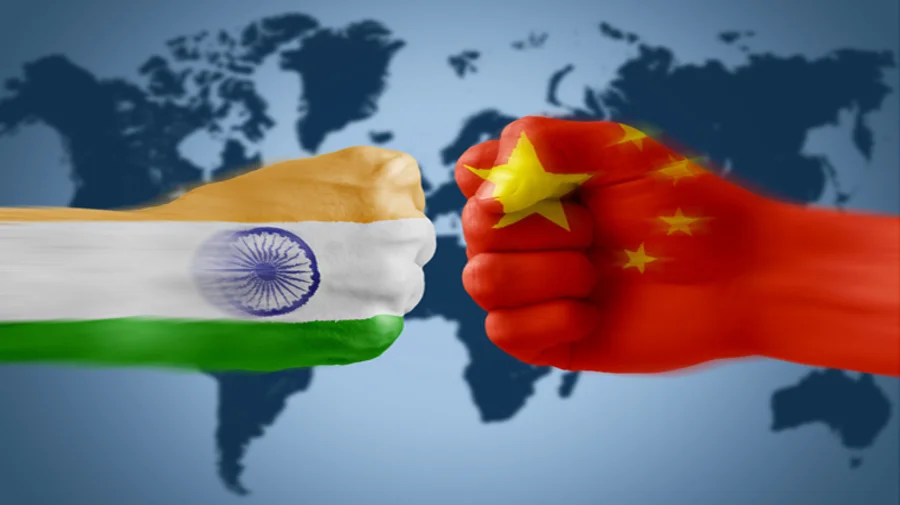
I present the rivalry between India and China in 2025 as a complex and multilayered phenomenon which is continuously defining the political, economic and security dynamics of Asia, and therefore, I stress that it is no longer exhausted solely in the borderline tensions in Ladakh and Sikim, but it encompases a wide specter of fields – from trade and infrastructure, through digital technologies, up to regional coalitions. Such a configuration of relations demands analytical precision, because behind periodical incidents on the field lies an analytical depth of a crisis maintained by both actors as a mechanism of pressure and demonstration of strategic resilience.
India and China are transferring their dispute to countries such as Nepal, Bhutan, Myanmar, and Pakistan, thus making the region an arena for a long-term projection of power. China is utilizing modernized monitoring systems, mobile units, and infrastructure projects within BRICs as instruments of political presence. At the same time, India responds with investments in corridors, military mobility, and the development of its own supply chains. Regarding this, localized incidents do not represent isolated events, but are a part of a wider logic that generates a predictable, but constantly present level of tension.
In the wider strategic framework, I thus present the role of international actors: NATO and the US are monitoring the situation through the prism of the Indo-Pacific strategy, while Russia and Pakistan are using their rivalry to strengthen their positions in the regional security architecture. The economic dimension of the competition is gaining significant weight because trade balance, infrastructural investments, and technological standards shape long-term patterns of inter-dependence. Regarding this, the 5G, artificial intelligence, and space technologies competition is becoming one of the key factors of securitization of everyday life, where digital infrastructure transitions from a technical into a strategic category.
At the same time, I am following the formation of new coalitions. Quad coordinates regional deterrence and political cooperation, while the Russo-Chinese partnership is growing stronger through energy and military dimensions. India, on the other hand, relies more on regional arrangements with Bangladesh, Nepal, and Myanmar, tending to construct an alternative network of partnerships that can amortize the Chinese influence. These processes occasionally include more superficial political interactions, but integrally speaking, they reflect the gradual reshaping of the regional order in the direction of multipolarity.
When I analyze the risks in 2025, I especially stress three points: escalation of border incidents, the use of economic dependence as an instrument of pressure, and technological-digital tensions that open up a new line of confrontation. Small tactical shifts at the border can have an immeasurably big strategic effect due to their impact on trade flows, security calculations, and international perception of stability. Regarding this, the technological competition is additionally strengthening the insecurity, because each innovation is instantly being interpreted as a military or geopolitical advantage.
The most probable scenario for the next two years leads to an intensification of the competition within the multipolar structures, in which India tends to balance the Chinese domination through a combination of economic partnerships, regional initiatives, and technological development. Regarding this, I conclude that the rivalry no longer functions as the issue of a territorial dispute, but as a comprehensive strategy that encompasses economy, technology, diplomacy, and military infrastructure. Such dynamics shape the contemporary model of Asian geopolitics, in which the infrastructure and capital become the instruments of deterrence, while the stability of the region reflects into a constant management of tensions, and not its dissolution.
Author: Miljan Petrović