
July 2025
The overthrow of Bashar al-Assad in December 2024 marked the end of an era in the contemporary history of Syria, but did not bring about stability. The vacuum at the state level that followed opened up a space for actions of new actors – local militias, regional 0owers, and tribal councils – who are now attempting to consolidate control over their territories. With the former leader of the paramilitary formation Hayat Tahrir al-Sham, Ahmad al-Shaara, as head of the state, and the institutionalization of paramilitary, terrorist, and rebel groups through their integration into the national armed forces of Syria, the picture is not optimistic. In this mosaic order, the southern part of Syria, and especially the Suwaidah Province, has once again become the epicenter of internal resistance and foreign calculations.
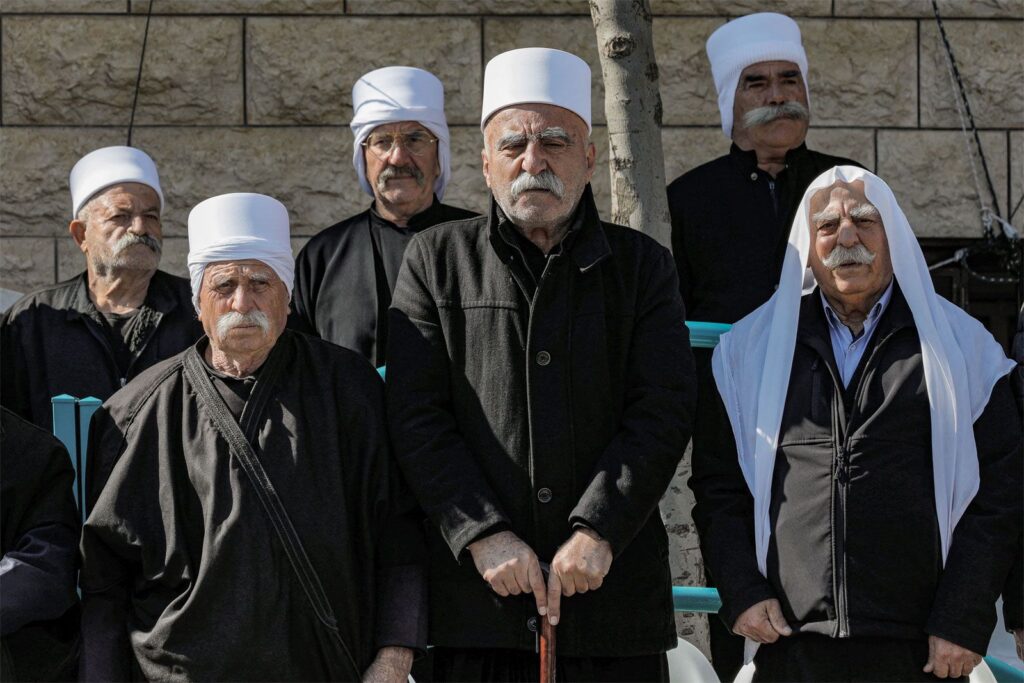
The Druze resistance in Suwaidah, which for years remained on the border of an open conflict with Damascus, turned into an organized political and security project after the fall of the regime. Led by the combination of local nationalism, protection of religious community, and tendencies towards autonomy, the Druze have established the Suwaidah Military Council, a structure that now seems like a de facto regional government. Their goal is not separatism, but a self-government within the new confederative Syria, which is increasingly often imposed as a possible outcome of the current fragmentation of the country.
While Suwaidah is attempting to position itself as the bastion of stability in the southern chaos, the regional forces are using the vacuum of power. Jordan, which has long perceived South Syria as a buffer zone against the Iranian influence and drug trafficking, is now playing a more active role by supporting the moderate Druze factions and by providing them with logistical assistance. On the other hand, Iran significantly lost its leverage in Damascus, but it is still attempting to maintain its presence through the remainder of the Shia militias in Daraa and Quneitra near the Golan Heights, to preserve its influence on the Tehran-Beirut axis.
Israel, on the other hand, is using the post-Assad situation to create the “Southern belt of stability”, where the Druze, with explicit neutrality, would represent the buffer zone between the Israeli border and the Syrian chaos. The Israeli interest is clear: to eliminate the presence of Iranian and Hezbollah elements and prevent the formation of new military structures that would endanger the security of the Golan. This dynamics makes Suwaidah, once peripheral, have a geostrategic role that surpasses its demographic weight.
The political model of the Druze in Suwaidah is based on the combination of traditional tribal council and contemporary institutional forms. However, the legitimacy of the new structure is not absolute: within the community itself, there are cleavages between the moderate and militant currents. While some are attempting to form a regional council that would join the new transitional parliament in Damascus, others insist on complete independence, which leads to frequent armed incidents.
By the summer of 2025, the image of Syria will have completely changed. The northeastern part of the country is under the control of the Kurdish forces, with US support, even though they accepted in March 2025 to integrate into the national armed forces; the North and the West are under the influence of Turkey and its allies; center is the zone under control of the new government; and the South is becoming a symbol of the fight for local autonomy in the debris of the centralized state.
The Druze resistance, in this context, represents a prototype of the new Syrian political identity – based on local responsibility and relative neutrality towards foreign forces. Even though the international community, and especially the European Union, is currently dealing cautiously with supporting these structures, in diplomatic circles, there is an increasingly present stance that, after Assad, it is not possible to integrate Syria into a single country without recognition of regional autonomies.
The scenario of the southern part of Syria in the second part of the year of 2025 remains uncertain. If Suwaidah succeeds in maintaining the institutional cohesion and avoiding internal cleavage, it could become a model for political decentralization in other parts of the country. However, if the foreign influences intensify – especially through competition between Jordan, Iran, and Turkey – there is a risk that the region will be drawn into a new cycle of conflicts, with an emphasis on the activities of the proxy forces.
For Syria, whose state identity already fell into the zone of deep backsliding, Suwaidah represents the last test of the ability of local communities to define their futures themselves. If the Druze succeed in maintaining the balance between self-government, security, and regional neutrality, they could become one of the rare factors of stabilization in the already broken post-Assad landscape of the Middle East.
Author: Tanja Kazić