
February 2025
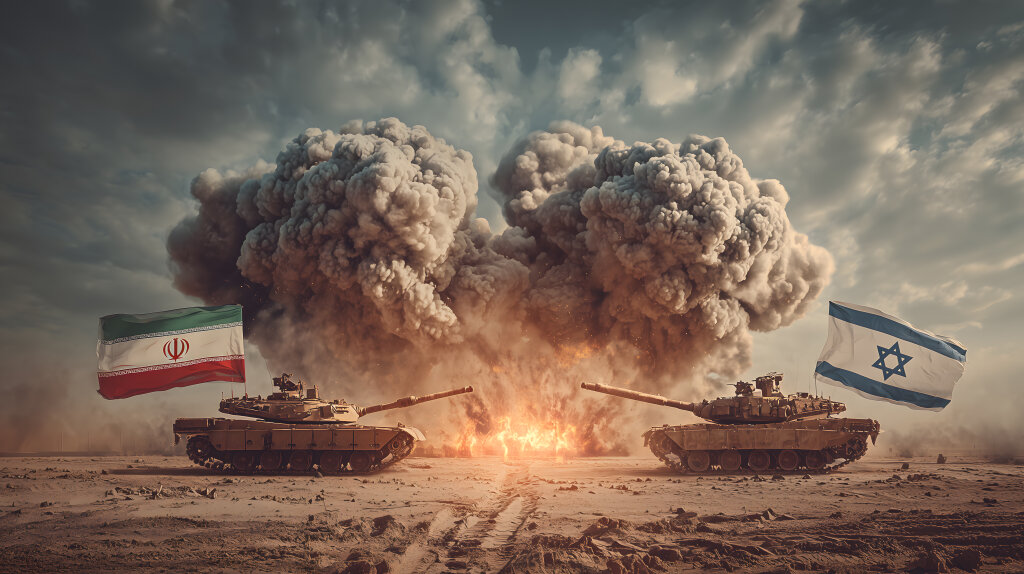
The European analytical circles have long been seeing the Iran-Israel conflict as a constant source of instability, which, from time to time, changes its form and intensity. However, in the beginning of 2025, it is growing into something much wider – into a systemic problem of the global security architecture. Regarding this, the first direct ballistic attack of Iran against Israel at the end of 2024 seems as the moment when the covert conflict is entering the overt phase, when the two countries are ceasing to play with shadows and start testing the tolerance threshold of the international order.
For years, Tehran and Jerusalem waged their war via proxies, thus creating an analytical depth of the crisis through their fronts in Syria, Lebanon, Iraq, and Yemen. Israel used precise operations and assassinations for systematically undermining the Iranian influence network, while Tehran carefully chose for a moment to inflict a direct response – a ballistic strike which was both a signal and a message. Regarding this, Iran is not seeking a total war, but it is attempting to present itself as being ready to react when it estimates that their interests and violated and thus maintain its credibility in the region.
Israel is responding by its own reflex, accelerating the integration of the anti-rocket defense with the US and some Arab countries from the Gulf, thus showing that, in the conditions of controlled chaos, regional alliances can be reconfigured. Regarding this, each rocket is becoming a political message, and each defense is a diplomatic move. Tehran, on the other side, is using the moment to show that sanctions did not diminish its ability to act, while Jerusalem is reminding us that military superiority is still the basis of its deterrence tactic.
On an internal plan, both Iran and Israel are using the crisis as a means of political consolidation. In Iran, the hard line is strengthening the idea of resistance and self-confidence of the regime. In Israel, the ruling coalition is using the sense of external threat to homogenize the society and temporarily suppress the dissatisfaction regarding Gaza and the Israeli economy. Regarding this, each escalation also has an internal function – it is measured not only by the number of rockets, but also by political rating, social tensions, and narrative control.
As the conflict spills over the borders, the region is entering a new phase of securitization of everyday life. Saudi Arabia and the United Arab Emirates are balancing between deflecting confrontation with Iran and strengthening relations with Washington and Tel Aviv. Lebanon remains in a state of constant instability, Hezbollah maintains low-intensity pressure, while the pro-Iranian militias in Iraq are using this situation to conduct attacks on American bases. In Europe, the growing concern because of the Hormuz Strait and the Red Sea is transforming into a real economic pressure, exhibited through the increase in energy prices. Regarding this, the cyber threats and market instability at the beginning of 2025 show that the analytical depth of the crisis is surpassing regional frameworks.
In the strategic sense, both sides are leading a game whose outcome cannot be predicted with certainty. Israel knows that an excessive military reaction could collapse its relations with the Arab partners and cause a drift with Washington. Iran, still, understands that an open conflict would jeopardize the economic stability and political structure of the regime. The conflict remains a sort of an experiment of controlled chaos – it seems rational, but contains all risks that could lead us to wrong assessment and chain reactions.
The ballistic shadow that is looming over the Middle East is not exclusively the result of military calculations but also a consequence of a deep imbalance of the international system. The technological precision of weapons is not bringing along political stability but is, in fact, prolonging the state of uncertainty, which is increasingly affecting the global order. Regarding this, it seems that the world is entering a new era – in which stability is no longer measured by peace but by the ability to function within the state of permanent instability.
Author: Miljan Petrović